
by Charlton “Chuck” Stanley
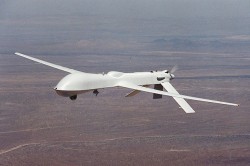
Predator UAV
We have all heard about the so-called “drones” and what they can see. What the general public has not seen is their true capability. Of course, we have all seen the black and white YouTube and LiveLeak videos taken from attack aircraft in Iraq and Afghanistan, but those are imaging systems for targeting, not general surveillance. The correct name for drones is Unmanned Aerial Vehicles (UAV). The Predator has gotten a lot of publicity. This airplane is about the same size as a family Cessna or Piper airplane at your local airport. It does surveillance, of course, but is also an attack aircraft. It has a limited range of 675 miles. The somewhat larger Reaper is similar, but can carry a bigger payload farther and higher. It has twice the range of the Predator, and can fly up to 50,000 feet. Both these UAVs are designed for relatively short missions and can carry weapons.
However, there are other UAVs designed specifically for silent “eye in the sky” surveillance over a wide area, and can stay aloft for days at at time.
At 17,000 feet, you cannot see an aircraft the size of a Predator or Reaper. They are so far away as to be invisible. However, they can see you. DARPA funded research has created cameras capable of incredible resolution. A high end Canon or Nikon camera costing a four figure price tag may have 21 to 25 megapixel resolution. A megapixel is one million pixels. How about a camera with billions of pixels?
Here is an excerpt from a PBS special about this new camera technology. For me, it raises a lot of questions regarding the future of privacy in this country.
There is only one thing wrong with this story. The Autonomous Real-Time Ground Ubiquitous Surveillance Imaging System (ARGUS) has 1.8 billion pixels (1.8 gigapixels), according to the report. Despite the claim, this is NOT the world’s highest definition camera.
David Breashears, a distant relative of mine, has built a 3.8 billion pixel (3.8 Gigapixel) camera. This link takes you to an interactive photo of Mt. Everest taken by David and his team. Notice the small green boxes in the picture. Hover your cursor just below the green box, and it will change to the little hand with pointing finger. Click that, and it will zoom in. However, once it zooms in, look for one or more green boxes and click them. There are boxes within the boxes. Those photos are taken from an even greater distance than those in the video.

 Nicole Plyler Fisk
 Gene Howington
 FFS Guest Blogger
 Joy of Fishes
 Chuck Stanley
 shortfinals
 Terry Welshans
 ann li-summers
 wordcloud9


 Flowers For Socrates
Sometimes folks get paralyzed by what they see, even if by drones or other eyes in the sky:
An interesting bit of imaging technology I read about some years ago was called, I believe, “perfect lensing.” The idea was that by shining a laser, designed to be about half a pixel in diameter, through a given lens, one could map where every point on the outer lens mapped to the sensor for the camera; and by doing that we would know the precise effects of any imperfections in the lens and could form a mathematical transformation to correct for them; giving the image that would be registered in the lens were perfect. It would be a custom transformation for each combination of lens and sensor array, but… easily automated and a small price to pay for perfection.
I meant “giving the image that would be registered IF the lens were perfect.”
Tony,
After it was launched into orbit, NASA discovered the mirror of the Hubble Telescope was ground wrong, giving an unusable image. They used some kind of similar technology to “fix” it, correcting for the aberration.
There is seeing and there is seeing. But they are not the same, no matter how detailed.
Charlton: As I heard it, that was a bad physics computation (with the Hubble); which made the corrective lens an actual lens. The grinding was accomplished by an arm extending from the center of the lens and traveling out. The grinding was digitally controlled, but the calculations of depth failed to account for the extra weight of the arm itself holding the polishing head; as it was extended the weight pulled it lower and it buffed off more of the lens (microscopically more). That is why the fix was relatively easy; and actually a corrective lens; because the error followed a smooth and monotonic function that was easy to program (once the error was discovered).
Actually, using the same kind of laser procedure as a testing protocol, they might well have discovered that error before the lens ever left Earth, and saved themselves some embarrassment.
Tony,
At one time I had the Scientific American three volume set of books on amateur telescope making by Albert Ingalls. I recall the Ronchi and Foucault Tests and remember wondering why on earth did they not do the tests before launch.
One of my favorite sections in physics class was optics. During ensuing years I have managed to forget almost everything I learned.
Charlton,
In undergraduate Astronomy I found it fascinating how much information one can glean from a single point of light, which is what all these stars are. Redshift, rotation, size of the star, and (by spectral analysis) composition, intervening clouds and their composition. And now if they have planets, the size and orbit of them, the composition of planetary atmosphere. Probably more stuff I am forgetting, it is amazing so much information can be squeezed out of one point that I would have to memorize a full list!
Chuck,
that is some spectacular technology both from ARGUS and from your cousin’s work. For human’s I guess the idea is that privacy has already escaped the barn. The question is how it will be used and that is really a Hobson’s choice.
Mike & Tony,
My concern is not the existence of the technology. We knew that was coming. A couple of years ago, over on Daily Kos, one user posted a Google Earth shot of his house. He and his wife were unloading laundry from their car, and you could easily make out what they were wearing and the color of the laundry baskets. That photo was shot from 23,000 miles up by a satellite camera in stationary orbit. I haven’t checked on what they are launching in recent years, but at one time, those satellite cameras were the size of an SUV, and too big to put in a small airplane.
The piece I wrote about Edward Snowden’s interview last week on Res Ipsa Loquitur still has legs, and as a result, the only person with more hits than me is Jonathan. People are interested, and the world wide general public–and their own government leaders–are coming to realize the degree to which our leaders can’t be trusted. That is the real takeaway from this.
Chuck,
I just posted the following Mark Fiore political cartoon video at Res Ipsa Loquitor:
Obama’s NSA State of the Union
Feb 11 is The Day We Fight Back get on board.