
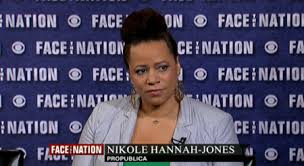
Nikole Hannah-Jones
By Elaine Magliaro
Nikole Hannah-Jones is an award-winning journalist who joined ProPublica in 2011. Her writings focus on segregation and discrimination in housing and schools. Previously, she covered governmental issues, the census, and race and ethnicity at The Oregonian. Hannah-Jones won the Society of Professional Journalists Pacific Northwest Excellence in Journalism Award three times and the Gannett Foundation Award for Innovation in Watchdog Journalism.
Last week, Hannah-Jones published an article titled Yes, Black America Fears the Police. Here’s Why. (ProPublica & Politico). She opens her article with a personal tale about an excursion that she took with her family and friends to Long Island to celebrate the Fourth of July last summer. While she and her family were walking along the shore, “a young man extended his arm and fired off multiple shots along the busy street running parallel to the boardwalk.”
According to Hannah-Jones, the gunshots stopped as quickly as they had started…and the man then “disappeared between some buildings.” While she, her husband, and friends looked at each other in disbelief, the author of the article turned to check on Hunter, “a high school intern from Oregon who was staying with my family for a few weeks.” Hunter was talking to someone on her cellphone–and explaining that there had just been a shooting on the beach. Hannah-Jones said she couldn’t imagine whom her intern would have called at such a time…so she asked her “somewhat indignantly, if she couldn’t have waited until we got to safety before calling her mom.”
Hunter explained that she had called the police. Hannah-Jones said that she and her friends “locked eyes in stunned silence. Between the four adults, we hold six degrees. Three of us are journalists. And not one of us had thought to call the police. We had not even considered it.”
Hannah-Jones:
We also are all black. And without realizing it, in that moment, each of us had made a set of calculations, an instantaneous weighing of the pros and cons.
As far as we could tell, no one had been hurt. The shooter was long gone, and we had seen the back of him for only a second or two. On the other hand, calling the police posed considerable risks. It carried the very real possibility of inviting disrespect, even physical harm. We had seen witnesses treated like suspects, and knew how quickly black people calling the police for help could wind up cuffed in the back of a squad car. Some of us knew of black professionals who’d had guns drawn on them for no reason.
This was before Michael Brown. Before police killed John Crawford III for carrying a BB gun in a Wal-Mart or shot down 12-year-old Tamir Rice in a Cleveland park. Before Akai Gurley was killed by an officer while walking in a dark staircase and before Eric Garner was choked to death upon suspicion of selling “loosies.” Without yet knowing those names, we all could go down a list of unarmed black people killed by law enforcement.
Hannah-Jones explained why she and her friends hadn’t entertained the thought of calling police: “We feared what could happen if police came rushing into a group of people who, by virtue of our skin color, might be mistaken for suspects.”
Hannah-Jones quoted author Khalil Gibran Muhammad, author of The Condemnation of Blackness, who wrote, “White people, by and large, do not know what it is like to be occupied by a police force. They don’t understand it because it is not the type of policing they experience. Because they are treated like individuals, they believe that if ‘I am not breaking the law, I will never be abused.’”
Hannah-Jones said many white Americans “seemed shocked by the gaping divide between law enforcement and the black communities they are supposed to serve” as protests and revolts “swept across the Missouri suburb of Ferguson and demonstrators staged die-ins and blocked highways and boulevards from Oakland to New York with chants of ‘Black lives matter.’” She noted that black Americans were not surprised.
Hannah-Jones:
For black Americans, policing is “the most enduring aspect of the struggle for civil rights,” says Muhammad, a historian and director of the Schomburg Center for Research in Black Culture in New York. “It has always been the mechanism for racial surveillance and control.”
In the South, police once did the dirty work of enforcing the racial caste system. The Ku Klux Klan and law enforcement were often indistinguishable. Black-and-white photographs of the era memorialize the way Southern police sicced German shepherds on civil rights protesters and peeled the skin off black children with the force of water hoses. Lawmen were also involved or implicated in untold numbers of beatings, killings and disappearances of black Southerners who forgot their place.
In the North, police worked to protect white spaces by containing and controlling the rising black population that had been propelled into the industrial belt during the Great Migration. It was not unusual for Northern police to join white mobs as they attacked black homeowners attempting to move into white neighborhoods, or black workers trying to take jobs reserved for white laborers. And yet they strictly enforced vagrancy laws, catch-alls that gave them wide discretion to stop, question and arrest black citizens at will.
Much has changed since then. Much has not.
Hannah-Jones had much more to say about why black Americans fear the police. Click here to read the rest of her article.
SOURCES
Yes, Black America Fears the Police. Here’s Why. (ProPublica)
Nikole Hannah-Jones (ProPublica)
 Nicole Plyler Fisk
 Gene Howington
 FFS Guest Blogger
 Joy of Fishes
 Chuck Stanley
 shortfinals
 Terry Welshans
 ann li-summers
 wordcloud9


 Flowers For Socrates
The anecdote Ms. Hannah-Jones relates is telling:
“Hannah-Jones said that she and her friends “locked eyes in stunned silence. Between the four adults, we hold six degrees. Three of us are journalists. And not one of us had thought to call the police. We had not even considered it.”
These intelligent, highly educated Black people each instinctively understood that the police could and most probably would have treated them with suspicion and disrespect. This is the distinction that most of White America doesn’t get. In my own life I have had more than a few instances of being treated disrespectfully by police, but those are of little consequence compared to those facing people of color. Racial prejudice in this country runs deep, as does the denial of it by many White Americans. Unfortunately, prejudice and bigotry will not disappear through legislation. The only hope for dealing with it is education and exposing people to the true state of affairs. While I’m somewhat glum as to that happening, evidence like the DOJ report on Ferguson is something that needs dissemination. However, as we have seen here at FFS, there are those who have greeted the report with denial of its validity.
The article is well worth reading in its entirety. Thanks, Elaine
I have come to realize that the reasons the cops get away with brutalizing minorities (poor, homeless, mentally ill, regardless of color; black and brown, because of color) is because those with the political power want to get rid of those being brutalized.
Albuquerque seems to want to become a haven for well-off (white) retirees. Getting rid of the powerless minorities seems to be a part of that plan.