
By GENE HOWINGTON
Graphic art such as posters, paintings and film can be and often are considered works of art. Can propaganda using these mediums be considered art? Propaganda posters are considered art by many and in the design industry “propaganda” is considered a style all its own. Consider these examples and decide if you think they constitute art as well as propaganda.
-

- Lord Kitchener wants you!
-

- Uncle Sam wants you!
-
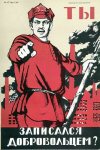
- The Red Army wants you!
Join the Flowers for Socrates Force as we discuss yet another facet of propaganda!
This means you!
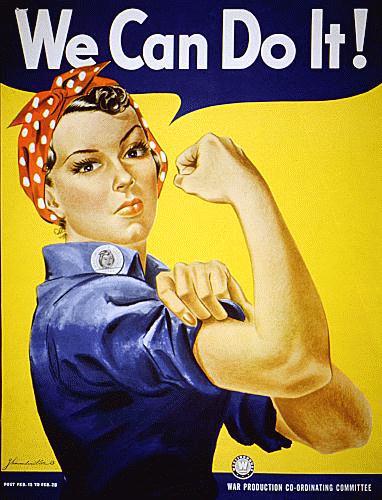
“We Can Do It!” a.k.a. “Rosie the Riveter” is one of the best known iconic images in American culture.
As previous instalments in this series discussed, not all propaganda is verbal. Some propaganda images have become iconic parts of our culture. Rosie the Riveter is a perfect example of an image created as propaganda that has moved on to become something else altogether in our cultural subconscious. Images, like words, have both denotative and connotative value. The imagery, iconography and symbolism of the subject matter can influence your thinking on a subject as surely as words do and such choices as color, composition and fonts can have an even subtler but equally profound psychological effect on the viewer.
World War I and World War II were pinnacles in the use of the propaganda poster. Most of these examples come from American, British and Russian propaganda from those eras. One of the first thing that becomes apparent when studying the history of propaganda in this medium is that there are thematic commonalities. Join the military (as the gallery at the beginning of this article illustrates), support the troops/bring them home, commemoration of a date or event, buy war bonds, careful to who you talk to and what about, strength through unity, save materials for use in the war effort, the soldiers are protecting you and/or threatened, the bad guys are really bad (possibly even sub-human). This is not an all inclusive list of themes to be certain, but the following galleries contain examples of propaganda posters grouped by like theme. Some of them are graphically appealing in their design on a purely aesthetic level. Some of them are direct. Some are appeals to emotion. Some are appeals to nationalism. Some work to define “the Other”. They all carry a message.
Commemorative Messages:
-
- For Russian Constitution Day – “The Family Under Government Protection”
-
- Commemorating Pearl Harbor
-
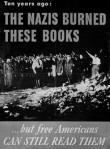
- Commemorating Nazi Book Burning
Buy War Bonds:
-
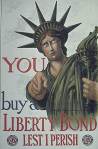
- WWI U.S. Liberty Bonds
-

- WWI Russian War Bonds
-
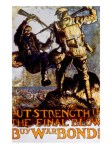
- WWI British War Bonds
Be Careful What You Say And Who You Talk To:
-
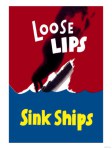
- The classic example from WWII America.
-
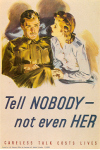
- WWII British
-

- WWII Russian
Save Materials:
-
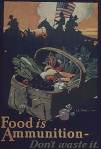
- WWI American – Save Food
-
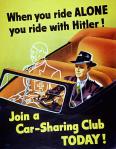
- WWII American – Save Gas
-

- WWII American – Save Office Supplies
Produce To Support The Troops:
-

- WWII American – “Production”, the message is clear.
-
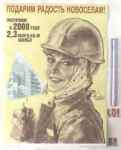
- 1988 Russian – The “Russian Rosie” urging the building of housing during the Afghan conflict.
-
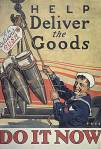
- WWII American – Quit Yer Slackin’!
These Are Really Bad Guys:
-
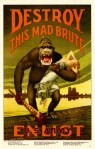
- WWI American – The Kaiser as a gorilla.
-

- WWII American – The hands on approach.
-
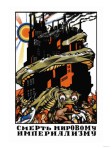
- Russian (Period Undetermined) – “Kill the Imperialist Monster”
-

- WWII American – Brutally dehumanizing all the way around.
-
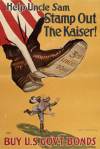
- WWI American – Who knew the Kaiser was so short?
-
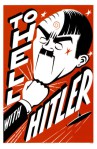
- WWII American – The poster says it all.
Does the fact that they carry a message negate their artistic merit? If you answered yes, consider the last instalment of this series on architecture as propaganda and ask yourself that question again. Does the propaganda power of the Great Pyramid or Abu Simbel automatically negate their artistic merit? I think the only reasonable answer is no. Both are not only amazing works of architecture, but artfully done as well. Now ask yourself does the content of the message matter in your evaluation? Does remoteness in time change your willingness to see propaganda as art? Consider these examples of Nazi propaganda posters.
-

- “Hitler Builds”. From 1933.
-

- The text reads “The Jew: The inciter of war, the prolonger of war.” Late 1943 or early 1944.
-

- Hitler as a Christ-like figure. From the 1930′s.
-

- Commemorating the 10th anniversary of the Nazi rise to power. From 1943.
-

- German produced propaganda in Russian. The text reads “Get the Jewish-Bolshevist warmongers out of Europe!”. From 1941.
-
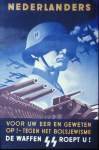
- A Dutch language SS recruiting poster used in the Netherlands occupation (1940-1945).
-
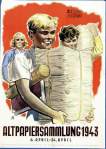
- A 1943 Nazi paper drive.
-
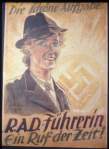
- The 1930′s Nazi equivalent of Rosie the Riveter. The text reads, “A wonderful task: Reich Labor Service Women’s Leader: A job for today!”
-

- A poster for the 1939 Nuremberg Rally, ironically called “The Rally for Peace”, it was cancelled due to the war.
Can you consider these works on artistic merit or does the message – and its attendant closeness in time – prevent you?
What if a noted and famous artist produced a propaganda painting? Is that art simply because of the creator’s bona fides in the art world? Consider the work of famous American painter Thomas Hart Benton. Titled “The Sowers”, it is part of an eight piece series of paintings Benton did in the 1940′s depicting the violence and barbarity of fascism. From 1942, it is the portrait of a brutish, monster-like man sowing not seeds, but skulls:
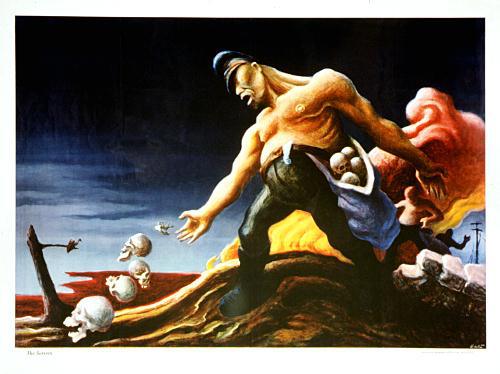
“The Sowers” by Thomas Hart Benton
To further demonstrate the style in and of itself, what about propaganda posters designed as a tie-in to entertainment or as direct advertising?
Faux-Propaganda Posters for the (excellent) 2003-2008 television series “Battlestar Galactica”:
-
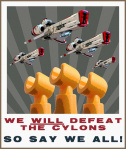
- Got to beat those Toasters!
-

- WARNING: Enemy may be hot!
-
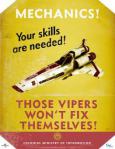
- Gotta fly!
Candy Marches On!:
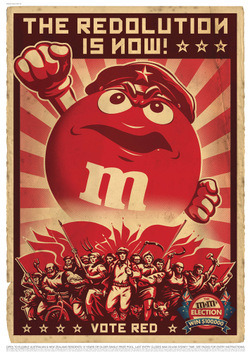
Personally, I’m a fan of Green . . .
Mass media changed the face of propaganda. Mass produced newspapers, film, radio, television and the Internet all changed the way those with a message they wanted to sell and opinions they wanted to shape went about their mission. In America, some would say in the world, there is no greater producer of media than Hollywood. New York places a strong second, but their speciality since the early days of the industry has been television. In a way, film and television – despite their more transitory nature than something like great works of architecture – have become our modern cultural monuments of choice.
Animation is the nexus of graphic arts and film and it has been used for propaganda both here and abroad. A fair warning, these cartoons feature racist and/or dehumanizing characterizations about whatever “Other” they are trying to portray as the enemy. Although animation is not strictly for children, it holds a strong attraction for them, and these examples can be considered exemplary of one of the lowest tactics of propaganda – that which is aimed at children – and reflecting a maxim in propaganda that it is best to “catch them young”.
Banned WWII-era banned cartoon making fun of the Japanese and the Nazis:
Daffy Duck in Daffy the Commando:
A Russian example with subtitles – The Millionaire:
A Nazi war propaganda cartoon aimed at the French to convince them that the Allies were attacking them as well:

Poster for the 1940 propaganda film “Jud Süß”
In cinema, it is no different. The history of film used officially as propaganda traces its roots to World War II. Before the war, Germany was a hub of European cinema. Exploiting this asset, the Nazis had the Ministry of Propaganda under the leadership of Joseph Goebbels driving the production of antisemitic films like “Jud Süß“, “Die Rothschilds” and “Der ewige Jude“. In addition, the Third Reich was heavily involved in the production of the more nationalistic fare of films like Leni Riefenstahl‘s documentaries. Of her two most famous works, one is considered the most famous propaganda film in history. “Triumph des Willens” or “Triumph of the Will” is about Hitler and the rise of the Nazi Party to power. Her second most famous works are the pair of films known collectively as “Olympia” (“Olympia 1. Teil — Fest der Völker ” (Festival of Nations) and “Olympia 2. Teil — Fest der Schönheit” (Festival of Beauty)) that chronicle the 1936 Olympics in Berlin. The Nazi co-opting of the German film industry had the not so surprising effect of driving out some of their top talent who fled to Hollywood, such as actress Hedy Lamarr (who also aided the Allied war effort in her role as an inventor – a very interesting and insanely beautiful woman) and directors such as Fritz Lang and Otto Preminger.
In the United States during World War II, we had the Office of Wartime Information (OWI). Despite the fact that the overall net effect of propaganda of World War I was negative with many Americans feeling the propaganda from the previous war was not only misinformation, but possibly human rights violations, the Roosevelt administration went forward with a full media blitz from posters to radio to cinema. Some of the films were pure propaganda such as the series of films produced by Frank Capra at the behest of General George C. Marshall. Called “Why We Fight”, the series consisted of seven films made from 1942 to 1945: “Prelude to War” (1942), “The Nazis Strike” (1943), “Divide and Conquer” (1943), “The Battle of Britain” (1943), “The Battle of Russia” (1943), “The Battle of China” (1944), and “War Comes to America” (1945). They made no pretence to be anything other than what they were – propaganda.
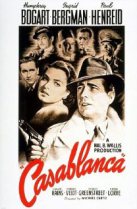
Poster for “Casablanca” – 1942.
Other films, however, worked in to the efforts of the OWI and were more commercial in nature. Did you know that “Casablanca” was propaganda? The hero of the film, Rick Blaine, is a man with an anti-fascist past who despite his personal misgivings and personal motivations to the contrary works to help his former lover and her freedom fighter husband escape the claws of the Nazis. The message is distinctly anti-Nazi and anti-fascism. That the film is art is practically without question as when you mention the very term “classic cinema” it is practically synonymous with “Casablanca”. Other films of the period were similarly slanted in their messages and some, like he 1942 film “Mrs. Miniver” (which told the story of an English housewife during the Battle of Britain and urged the support for the war effort) were even rushed into release at Presidential request. “The Purple Heart” (1944) dramatized Japanese atrocities and the heroics of American flyers. “Hitler’s Children” (1943) told the story of an American girl declared German by the Nazi government and her trials and tribulations with the Hitler Youth. “Dive Bomber” (1941) tells the heroic story of a military surgeon working with a Navy flying ace to develop pressure suits to keep pilots from blacking out in steep dives. These are but a few of many such examples of commercial films made with directed political messages. Even after World War II, the Hollywood/Washington propaganda nexus is alive and well.
The tail-end of Red Scare of the McCarthy era and the burgeoning Cold War brought us the rather unusual movie “Zots!” (1962). “Zots!” tells the story of a language professor who comes into possession of an ancient magic coin that gives him the power to inflict pain, slow down time or kill. In no time at all, Communist spies are out to get him and steal the coin for their own nefarious purposes. Directed by scholck-meister William Castle – best known for his cheesy horror films, “Zotz!” most certainly is a film, but it is so bad I don’t think anyone would mistake it for art. But anti-Communist propaganda? Without a doubt. The 1960′s and early 1970′s brought the United States the very unpopular Viet Nam War. It also brought us films like the highly unrealistic and jingoistic John Wayne fare, “The Green Berets” (1968). Today we are again involved in an unpopular war and again we have pro-war propaganda from Hollywood in the form of 2112′s “Act of Valor” where an elite team of Navy SEALs embark on a covert mission to recover a kidnapped CIA agent. Have you seen a commercial for this film? They are very proud of the fact that it stars not actors, but active duty Navy SEALs. Propaganda at its finest (?).
Television is no better. Much of what passes for entertainment is either direct propaganda or has propagandistic elements. Consider “Dragnet” – possibly the original pro-police propaganda program. A more modern example? Consider the show “NCIS” and its spin-off “NCIS: Los Angeles”, all of the programming on the Military History channel, and the consequential commercial advertising that supports most networks persuading you to buy things you may or most likely do not need. On most networks you are guaranteed at least twenty minutes out of every hour being devoted to persuade your or change your mind based on the interests of those who may or may not have your best interests at heart. I would say that as Americans you are awash in a sea of never ending propaganda, but the reality of the matter is that mass media has become a practically unavoidable global phenomena. Where mass media goes, propaganda surely follows. It is up to you to think for yourself and not succumb to the subliminal and overt efforts of others to think for you. That doesn’t mean you have to live in a cave. That means you have to consider what you see dispassionately even if it is something you enjoy or that entertains you in some way.
Can propaganda be considered art? I think that some of it most certainly can be, but that it is part and parcel of the idea of persuasion to make the idea being presented attractive. It is not art though merely because it is pretty. Something about it must transcend both the intentional message and the method of presentation to reach something universally human to truly be art. The perfect example of this is “Casablanca”. Enjoy it. I know I certainly do. However, I also keep in the back of my mind that it is a form of propaganda. Being aware of and asking the right questions about propaganda is the first step in protecting yourself from its undue influence.
Can propaganda be considered art?
Does intent of the speaker color the artistic merit of the piece?
Does remoteness in time affect the relationship of message to artistic merit?
What do you think?
As a reminder: when carrying on the fight to make sure you understand when propaganda is being used to manipulate you, be vigilant, thoughtful and emotionally detached when considering whether something is or isn’t propaganda. And above all . . .
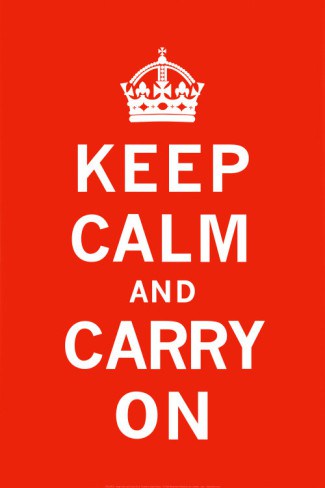
The first line of defense against propaganda is you!
NOTE: The column was originally published at Res Ispa Loquitur (jonathanturley.org) on June 17, 2012. It has been re-edited for presentation here.
__________________________
Disclaimer: All images used are either public domain or copyright of their respective copyright holder, used without permission and used for not-for-profit educational/illustrative purposes.

 Nicole Plyler Fisk
 Gene Howington
 FFS Guest Blogger
 Joy of Fishes
 Chuck Stanley
 shortfinals
 Terry Welshans
 ann li-summers
 wordcloud9


 Flowers For Socrates
Pingback: Propaganda 102 Supplemental: Holly Would “Zero Dark Thirty” | Flowers For Socrates
Pingback: Flowers For Socrates
Hi Gene, just wanted to say that I really enjoyed this post, as someone who is interested in the history of propaganda. Keep it up!