July 6th is
National Dollar Day *
National Fried Chicken Day

International Kissing Day
_________________________________________
MORE! Jan Hus, Molly Yard and the Dalai Lama, click
_________________________________________
WORLD FESTIVALS AND NATIONAL HOLIDAYS
Belarus – Kupala Night
(summer fire festival)
Comoros – National Day
Cook Islands – Ra ote Ui Ariki
(traditional chiefs’ gathering)
Czech Republic – Jan Hus Day *
Finland – Sonkajärvi:
Wife Carrying Championship
Kazakstan – Day of the Capital
Lithuania –
King Mindaugas’ Coronation Day *
Malawi – Independence Day
Marshall Islands – Fishermen’s Day
Peru – Teachers’ Day
Sweden – National Day
Zambia – Heroes Day
_________________________________________
On This Day in HISTORY
371 BC – Battle of Leuctra: The Boeotian League, which had been disbanded by the Spartans, is re-formed under Theban general Epaminondas. So Spartan King Cleombrotus I leads the Spartans to war, initially outwitting their enemies by marching through tough, hilly country to take the fortress of Creusis by surprise, but then they met the Boeotian army at Leuctra. In spite of having a smaller force, Epaminondas used them effectively, pushing the Spartan cavalry back into their infantry, disrupting an attempt by Cleombrotus to outflank the Theban left column, and massing his own cavalry and infantry in a 50-deep column formation that reversed the usual battle order, putting his most experienced troops, with the Sacred Band of Thebes as the front line, in direct opposition to the Spartan’s 16-deep column of veterans, and hurling them back, killing hundreds of Sparta’s most experienced soldiers, and their king. Sparta’s military superiority was broken, altering the Greek city-states balance of power

1189 – Richard the Lionheart becomes King Richard I of England
1253 – Mindaugas, first Grand Duke of Lithuania, is crowned as the first (and only) King of a unified Lithuania – King Mindaugas’ Coronation Day * an official holiday since 1991
1348 – When popular opinion blames the Jews for the Black Plague in Europe, Pope Clement VI issues the first of two papal bulls which condemn violence against the Jews. The pope says those who blame the plague on Jews have been seduced by the Devil’s lies, and urges clergy to protect the Jews as he has done
1387 – Blanche I of the House of Évreux born, Queen regnant of Navarre from the death in 1425 of her father King Charles III until her own death in 1441
1411 – Ming Dynasty Admiral Zheng He returns to Nanjing after the third treasure voyage and presents the Sinhalese king, captured during the Ming–Kotte War, to the Yongle Emperor, the third Ming ruler of China

1415 – Jan Hus, Czech priest, Bohemian Reformation seminal theorist and predecessor to Protestantism, is burned at the stake for heresy; commemorated as Jan Hus Day * His execution sets off the Hussite Wars, in which his followers defeat five consecutive papal crusades (1420-1431)

1483 – Richard III is crowned King of England

1484 – Portuguese sea captain Diogo Cão reaches the mouth of the Congo River
1535 – Sir Thomas More is executed for treason against King Henry VIII of England
1560 – The Treaty of Edinburgh is drawn up between the Commissioners of Queen Elizabeth I of England with the assent of the Scottish Lords of the Congregation, and the French representatives of King Francis II of France (husband of Mary Queen of Scots) to formally conclude the Siege of Leith and replace the Auld Alliance with France with a new Anglo-Scottish accord, while maintaining the peace between England and France as agreed by the Treaty of Cateau-Cambresis
1573 – The Siege of La Rochelle (1572–1573) ends, a massive military assault on the Huguenot-held city of La Rochelle by French Catholic troops during the fourth phase of the French Wars of Religion

1630 – Thirty Years’ War: Four thousand Swedish troops under Gustavus Adolphus land in Pomerania, Germany, to support and protect German Protestants
1699 – Pirate Captain William Kidd is arrested in Boston MA
1775 – The Second Continental Congress issues a “Declaration of the Causes and Necessity of Taking up Arms,” in which the colonists promise to lay down their arms when their grievances have been addressed and their liberties secured, but also indicate that the colonies may obtain foreign aid against Britain.
1776 – The American Declaration of Independence is announced on front page of the Pennsylvania Evening Gazette
1785 – National Dollar Day * – U.S. Congress designates “dollar” and decimal coinage as U.S. currency

1798 – The U.S. is on the verge of war with France, and the Federalist-controlled Congress passes the Alien Enemies Act, one of four acts increasing press regulations and restrictions against aliens. The Alien Enemies Act is later used by the Roosevelt administration during WWII as the basis for incarcerating Japanese Americans
1840 – German playwright Christian Friedrich Hebbel makes his reputation by writing his misogynistic play Judith, a reinterpretation of the biblical story to reflect the 19th century view of a “woman’s place,” turning Judith into a vengeful femme fatale who beheads Holofernes because he rapes her after her allure drives him mad. Hebbel, born in financially uncertain circumstances, had only been able to attend the University of Hamburg because of the patronage of Amailie Schoppe, a popular writer of the day. In 1846, he broke off his long-time relationship with Elise Lensing, who remained faithful to him for the rest of his life, and married instead the wealthy and beautiful actress Christine Enghaus, claiming, “a man’s first duty is to the most powerful force within him, that which alone can give him happiness and be of service to the world.” As Shakespeare put it: “Blow, blow, thou winter wind,/Thou art not so unkind/As man’s ingratitude . . .”
1848 – The Mexican-American war ends with the Treaty of Guadaloupe Hidalgo
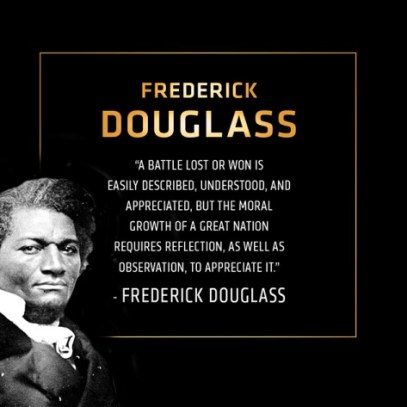
1853 – Opening day of the Colored National Convention, held for three days in Rochester NY; Frederick Douglass is the representative for the state of New York
1853 – William Wells Brown’s Clotel is the first novel published by an African American
1865 – The first issue of The Nation magazine is published
1885 – Louis Pasteur successfully tests his anti-rabies vaccine on Joseph Meister, a boy bitten by a rabid dog
1892 – Filipino Nationalist and Novelist José Rizal forms La Liga Filpina, an activist group for reforms, in Manila on July 3; on July 6, Rizal is arrested and then deported
1892 – Dadabhai Naoroji is elected as first Indian Member of Parliament in Britain
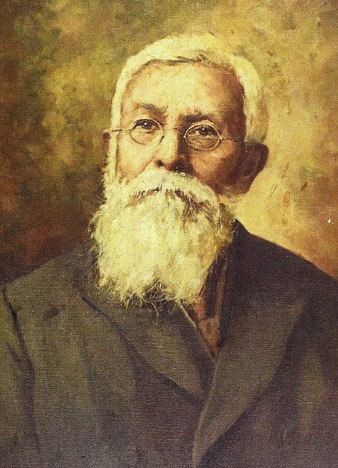
Dr. Dadabhai Naoroji, by V.R. Rao
1893 – The Homestead Strike: Unionized steelworkers at the Carnegie Steel Company in Homestead PA had won a favorable three-year contract after going on strike in 1889, but Andrew Carnegie was determined to break the union. His plant manager Henry Clay Frick stepped up production demands in 1892, then started locking out workers who refused to accept the new conditions. Then all of the plant’s workers are discharged on July 2, 1893, even though only skilled workers were members of the union. With little to lose, 3800 workers joined the strike called by the union. On July 6, three hundred Pinkerton agents, hired by Frick and armed with Winchester rifles, fought the huge crowd of steelworkers, leaving ten strikers and seven Pinkertons dead, and over two dozen wounded from both sides. The Pinkertons, overwhelmed, are forced to surrender. The local sheriff appeals to Governor Stone of Pennsylvania, who sends 8000 militia on July 12. The militiamen protect strikebreakers brought in to get the plant running again; by November, the strike ends with the union broken
1898 – President McKinley had signed a ‘treaty of annexation’ to take over Hawaii in 1897, but it failed to gain the two-thirds majority required in the Senate. Now, the U.S. Senate passes the Newlands Resolution already passed by the House of Representatives, which only required a majority vote in both houses, and McKinley signs it on July 7th. No Native Hawaiians were consulted
1900 – Frederica Sagor Maas born as the youngest daughter of Russian immigrants, American screenwriter, memoirist and author; became a story editor at Universal Pictures’ New York office in 1918, and was head of the department by 1923. In 1924, she moved to Hollywood, and went to work for MGM writing scripts, usually assigned to work with other writers, but her co-authors often took credit for her work, and her contract was not renewed. After that, she and her husband Ernest Maas sometimes worked together and pitched scripts to Fox and Paramount, with hit-or-miss success. After they lost most of their money in the 1929 stock market crash, they moved back to New York, then back out to Hollywood, but their indifferent success combined with some of their best story ideas suddenly re-appearing with other names as the authors, made them change careers. She became an insurance broker, and he was a story editor and ghost writer until he died in 1986. Urged by film historian Kevin Brownlow, she published her autobiography, The Shocking Miss Pilgrim: A Writer in Early Hollywood, at age 99, then lived to be 111
1907 – Frida Kahlo born, Mexican surrealist painter, best-known for her self-portraits, considered emblematic of national and indigenous tradition

1908 – Robert Peary’s North Pole expedition sails from New York Harbor
1912 – Molly Yard born in China to Methodist missionaries, American feminist and social activist; after graduating from Swarthmore College, she worked on several Democratic candidates’ political campaigns, including Helen Gahagan Douglas’ run for the U.S. Senate against Richard Nixon, who won by savaging Gahagan Douglas as a commie pinko, and later led the Western Pennsylvania presidential campaigns for John F. Kennedy and George McGovern. She co-founded the liberal lobbying organization Americans for Democratic Action (ADA), joined the National Organization for Women (NOW) in 1974, and was on its nationals staff by 1978, lobbying and fundraising for the Equal Rights Amendment (ERA) ratification campaign in Washington. She a senior staff member on the NOW Political Action Committee (1978-1984), then NOW’s political director (1985-1987), defeating anti-choice referendums in Arkansas, Massachusetts, Rhode Island and Oregon. Yard became NOW president (1987- 1991), and was one of the banner-carriers for the March for Women’s Lives in 1989, which drew 600,000 marchers to Washington. Won the Feminist Majority Foundation’s Lifetime Achievement Award

1917 – T.E. Lawrence and Auda ibu Tayi lead Arab forces to capture Aqaba
1923 – The Central Executive Committee accepts the Treaty of Union, signed in December of 1922, and the Russian Empire becomes the Union of Soviet Socialist Republics
1926 – Dorothy E. Smith born, Canadian sociologist, whose work covers women’s studies and feminist theory, family relationships, education and methodology; noted for developing institutional ethnology, a study of the social relations of actual people in everyday life (she described it as a “sociology for, not of the people”), and her contributions to the standpoint theory, the idea that hierarchies create ignorance at the top about social problems which those at the bottom understand from direct experience. Her research questioned the methods and theories of sociology up the 1970s, which she found were based on the male-dominated social structure, and overlooked women and minorities

1929 – Hélène Carrère d’Encausse born, French political historian of Georgian ancestry, specializing in Russian history; elected to seat 14 of the Académie française in 1990, and the Académie’s Perpetual Secretary in 1999; member of the European Parliament (1994-1999) for the right wing Conservative party RPR. Awarded the Polish Lomonosov Gold Medal in 2008 and Grand Cross with Star of the Order of Merit of the Republic of Poland in 2011
1932 – First class U.S. postage goes up to 3 cents
1935 – Tenzin Gyatso, future 14th Dalai Lama, is born

1937 – Bessie Emery Head, writer born in South Africa to a wealthy white South African woman and a black servant when interracial relationships were illegal; her mother’s family claimed their daughter was mentally ill, and sent her away to give birth without the neighbors knowing. After her mother killed herself, she was raised by foster parents and later in a mission orphanage. Qualifying as a teacher, she taught briefly, then became a journalist for The Golden City Post and Drum magazine (1958-1959), joined the Pan Africanist Congress (PAC) in 1960, and married Harold Head in 1961. In 1964, she left South Africa with her son, and sought asylum in the Bechuanaland Protectorate (which is now Botswana); she settled in Serowe, where she would set most of her novels and short stories; after 15 years, she became a Botswana citizen. Noted for her novels When Rains Cloud Gather, Maru, and A Question of Power. She died from hepatitis at age 48, just as she was starting to be recognized as a writer
1942 – Anne Frank and her family go into hiding in the “Secret Annexe” above her father’s office in an Amsterdam warehouse
1945 – Nicaragua becomes the first nation to ratify the United Nations Charter
1947 – The AK-47 goes into production in the Soviet Union
1957 – Chief Justice Earl Warren delivers the principle address at the dedication ceremonies for the Harry S. Truman Library
1960 – Maria Wasiak born, Polish politician and civil servant; a founding member of the Democratic Union, then headed the regional branch of the Freedom Union party (1995-1997); deputy-voivode of the Radom Voivodeship (governmental administrative division); President of Polskie Koleje Państwowe (PKP – the Polish State Railways – 2011-2012); Minister of Infrastucture and Development of Poland (2014-2015)
1964 – The Beatles’ film, A Hard Day’s Night, premieres in London
1964 – Malawi, formerly Nyasaland, declares its independence from the UK
1970 – California passes the nation’s first “no fault” divorce law
1971 – President Nixon authorizes a “special investigations” unit, dubbed the “Plumbers,” to root out and seal leaks to the media; their first target is Daniel Ellsberg – they
burglarize the office of Ellsberg’s psychiatrist, looking for information the White House can use to smear Ellsberg’s character and undermine his credibility
1976 – Ioana Dumitriu born in Romania, Romanian-American mathematician and academic; her research work includes the theory of random matrices, numerical analysis, scientific computing, and game theory. She was the first woman to become a Putnam Fellow, for making one of the top five scores at the William Lowell Putnam Mathematical Competition, and won the Elizabeth Lowell Putnam Award as the top woman in the contest in 1995, 1996, and 1997, a record she alone held for the next ten years, until it was equaled by Alison Miller. In 2012, she was one of the inaugural fellows of the American Mathematical Society

1983 – U.S. Supreme Court rules retirement plans can’t pay women less
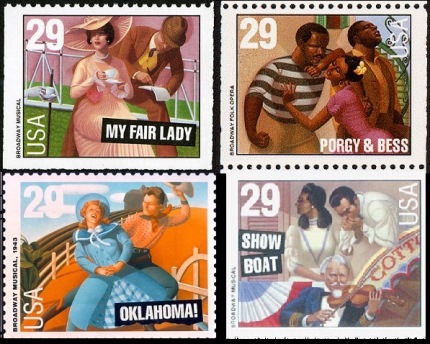
1993 – U.S. Postal Service releases 29-cent stamps honoring four Broadway musicals:
My Fair Lady, Porgy and Bess, Show Boat and Oklahoma!
1994 – The movie Forrest Gump, starring Tom Hanks in the title role, is released
2016 – The UK’s Iraqi War Inquiry, the Chilcot Report, is released. The report concludes that Prime Minister Tony Blair deliberately overstated the threat posed by Saddam Hussein; committed British troops before all peaceful options for disarmament had been exhausted; pledged his unqualified backing to U.S. President George W. Bush in July 2002, eight months before the Iraq invasion; that the process Blair’s cabinet used for determining the war was legal was “perfunctory,” the grounds were “unclear” and no formal record was made of the decision; British intelligence agencies produced “flawed information” about alleged Iraqi weapons of mass destruction; and the British military was seriously “ill-equipped” and the planning “wholly inadequate” for the invasion; and Blair never identified which ministers were to be responsible for postwar planning, contributing to strategic failure and safety risks for personnel before and during withdrawal
_________________________________________

 Nicole Plyler Fisk
 Gene Howington
 FFS Guest Blogger
 Joy of Fishes
 Chuck Stanley
 shortfinals
 Terry Welshans
 ann li-summers
 wordcloud9


 Flowers For Socrates