
August 14th is

Creamsicle Day
World Lizard Day

Social Security Act Day *
National V-J Day *
International Rosé (wine) Day
National Navajo Code Talkers Day *
_________________________________________
MORE! Ethel Payne, Max Klein and Lina Wertmüller, click
_________________________________________
WORLD FESTIVALS AND NATIONAL HOLIDAYS
Grenada – Carnival Tuesday
Morocco – Oued Ed-Dahab Day
(Return of province from Spanish control)
Pakistan – Independence Day
Saint Helena – Tristan da Cunha:
Anniversary Day
Vatican City – Assumption Vigil
Zimbabwe – Defense Forces Day
_________________________________________
On This Day in HISTORY
1040 – Scottish King Duncan I killed in battle by his first cousin Macbeth, who becomes his successor as King of Scotland
1183 – Taira no Munemori and the Taira clan take young Emperor Antoku and the three sacred treasures and flee to western Japan to escape from the Minamoto clan

Taira no munemori mikazuki osen ebizako no ju (Actors playing
Taira no Munemori, Mikazuki Osen, and Ebizako no Ju), painted by Utagawa Kuniyoshi
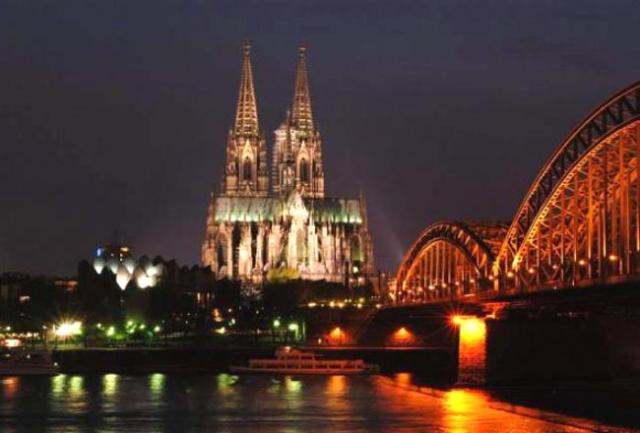
1248 – Rebuilding of Cologne Cathedral begins after it is destroyed by fire. It is not completed until August 14, 1880
1552 – Paolo Scarpi born, Italian historian, prelate, scientist and statesman on behalf of the Venice Republic; many of his writings are highly critical of the Catholic Church’s scholastic tradition
1642 – Cosimo III de’ Medici, Grand Duke of Tuscany, longest-reigning duke in Tuscan history, marked by ultra-reactionary edicts against prostitution and May celebrations, and economic depression; his wife left him and went into the Convent of Montmatre, after bearing three children
1738 – Leopold Hofmann born, Austrian composer; Kapellmeister at Peterskirche (St. Peter’s Church) and St. Stephan’s Cathedral in Vienna, where he asked for Mozart to be appointed as his assistant-Kapellmeister
1782 – Suriname forbids selling slave mothers without their babies
1802 – Letitia E. Landon born, British author and poet, known by her initials L.E.L., popular in the 19th century; Romance and Reality, The Improvisatrice
1820 – Dr. Edward Delafield opens first US infirmary exclusively for treating eye diseases in NYC
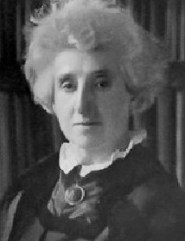
1848 – Margaret Lindsay Huggins born, Anglo-Irish astronomer and scientific investigator; her grandfather was an amateur astronomer, and shared his enthusiasm with her from an early age; she was unable to receive formal training in astronomy, but studied by reading many books, and viewing the stars, with her grandfather, and on her own with a spectroscope she constructed; she also became interested in photography. When she was introduced to astronomer William Huggins, it was the beginning of a lifetime collaboration, and they were married in 1875. They were the first to observe and identify hydrogen lines in the spectrum of the star Vega, and observed the Nova Aurigae of 1892. She was in charge of visual observations, and photography, mainly at the Tulse Hill Observatory, while they both kept meticulous notes, and he did more of the writing on publications of their findings. Beginning in the 1880s, she was listed as co-author of their publications, a rare acknowledgement for a woman at the time. They worked together for 35 years as equal partners. After Williams’ death in 1910, Margaret faced increasing health problems of her own. She donated her scientific papers to Wellesley College in the U.S., as she was a supporter of women’s education, and greatly admired the advances American women were making in education, and in opening up career opportunities for women
1851 Doc Holliday born, dentist, gambler, gunman
1863 – Ernest Thayer born, American writer; “Casey at the Bat”
1867 – John Galsworthy born, English novelist and playwright; 1932 Nobel Prize in Literature; The Forsyte Saga

1880 – Construction of Cologne Cathedral is completed in Germany after 632 years
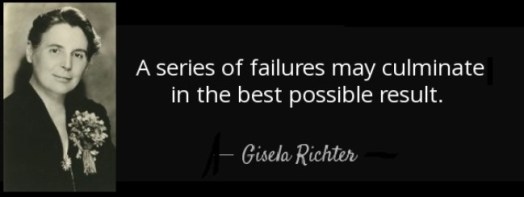
1882 – Gisela Richter born, prominent British-American classical archaeologist, art historian and author; attended Girton College (1901-1904) at the University of Cambridge, but Cambridge did not award degrees to women at that time; spent a year at the British School in Athens, then moved to the U.S. in 1905 and became an American citizen in 1917. She was hired as an assistant at New York’s Metropolitan Museum of Art in 1905, was promoted to assistant curator in 1910, then to associate curator in 1922. Richter was the Met’s first woman curator, of Greek and Roman art (1925- 1948), and one of the most influential figures in classical art history of the day; she wrote several popular books on classical art, which increased the general public’s understanding and appreciation of the subject, including Greek, Etruscan and Roman Bronzes; Animals in Greek Sculpture: A Survey; Roman Portraits; and A Handbook of Greek Art
1888 – Thomas Edison’s phonograph plays a recording of Arthur Sullivan’s “The Lost Chord” as a demonstration for the British press in London
1886 – Arthur J. Dempster born, American physicist, built the first device for measuring charged particles
1893 – Alfred Alessandrescu born, Romanian composer, conductor and pianist
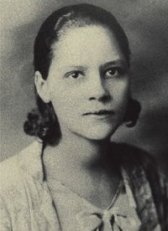
1895 – Amaza Lee Meredith born, African American architect, artist and educator. Her father was a white master stair builder, and her mother was black. They were unable to marry in Virginia, so they were married in Washington DC. Her father’s business suffered, and he committed suicide in 1915, when she was 20 years old. She never received formal training in architecture both because of her race and her gender, so she became an art teacher at Virginia State College, where she was the founder of the Fine Arts Department. In spite of her lack of training, she designed homes for many friends and family; her most notable design was for Azurest South, her own home which she shared with her companion Dr. Edna Meade Colson. After teaching elementary and high school classes for several years, she moved to New York to attend the Teacher’s College of Columbia University, receiving bachelor’s and master’s degrees in fine arts by 1934. In 1935, she began her career at Virginia State University, and started work on Azuret South, which was completed in 1939. In 1947, she formed the Azurest Syndicate to create Azurest North, an African American leisure community of 120 lots in Sag Harbor, where several of the homes were her designs. She retired from teaching in 1958, but continued to design buildings through the 1960s
1896 – Gold discovered in Canada’s Yukon Territory
1900 – A military force from eight nations lifts the siege of Peking, ending the Boxer Rebellion, which tried to purge foreigners from China
1901 – Alice Rivaz born, Swiss author and feminist, wrote about women in art and the family including Nuages dans la main (Clouds in your Hands) and Jette ton pain (Cast your Bread)
1903 – Eduardo Mallea born, Argentine novelist, essayist and short-story writer
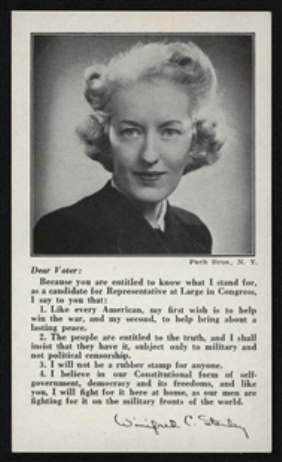
1909 – Winifred C. Stanley born, American lawyer and politician; as a member of the United States House of Representatives in the 1940s, she was the first to propose equal pay for equal work in HR 5056
1910 – Pierre Schaeffer born, French composer, acoustician and electronics engineer
1911 – Ethel Payne born, American writer, journalist and columnist for The Chicago Defender; “The First Lady of the Black Press” with a reputation for asking tough questions; the first African American woman radio and television commentator for a national news organization, for CBS (1972-1982); civil rights activist; associate of the Women’s Institute for Freedom of the Press; inaugural recipient of the Ida B. Wells Distinguished Journalism Chair in 1973
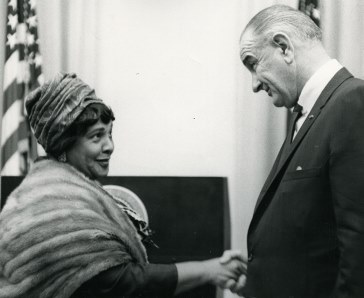
Ethel Payne with President Lyndon Johnson
1915 – Max Klein born, American painter; creator of “paint by numbers”

1917 – China declares war on Germany and Austria during WWI
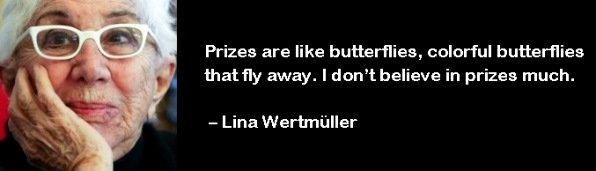
1926 – Lina Wertmüller born, Italian writer and director, first woman ever nominated for an Academy Award for Directing for her film Seven Beauties; also known for The Seduction of Mimi, Love and Anarchy and Swept Away
1935 – Social Security Day *- Franklin Roosevelt signs the Social Security Act
1941 – US Congress appropriated $83 million to build the Pentagon

The Pentagon in the 1940s – SHORPY photo
1941 – President Franklin Roosevelt and British Prime Minister Winston Churchill issue the Atlantic Charter, a statement of principles renouncing aggression
1941 – David Crosby born, singer-songwriter – The Byrds, Crosby, Stills, Nash & Young
1945 – National V-J Day *- U.S. President Truman announces Japan surrenders
1947 – Pakistan becomes independent from British rule
1953 – The whiffle ball is invented by David N. Mullany
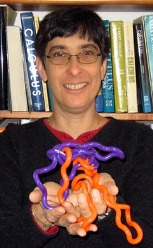
1956 – Erica Flapan born, American mathematician, known for research in low-dimensional topology, spatial graph theory and knot theory; professor of mathematics at Pomona College in California; recipient of a 2011 Deborah and Franklin Tepper Haimo Award for Distinguished College or University Teaching of Mathematics, from the Mathematical Association of America; became a fellow of the American Mathematical Society in 2012
1968 – Medy van der Laan born, Dutch Democrats 66 politician and chair or member of various councils and associations; chair of Energie Nederland, an energy company (2014 to present); member of the Supervisory Board of the Consumers Association (2007-2015); chair of the AOC council (2009-2014), a green education organization; Dutch Secretary of State for Culture and Media (2003-2006)
1969 – British troops arrive in Northern Ireland to stop sectarian violence between Protestants and Roman Catholics
1969 – Tracy Caldwell Dyson born, American chemist and NASA astronaut; Mission Specialist on the Space Shuttle Endeavour in 2007, and Expedition 24 drew member on the International Space Station in 2010; she completed three space walks, logging 22 hours, while repairing a malfunctioning coolant pump

1973 – U.S. bombing of Cambodia is halted
1980 – Workers go on strike at the Lenin Shipyard in Gdansk, Poland; this job action leads to the Solidarity labor movement
1982 – National Navajo Code Talkers Day * is proclaimed by President Reagan
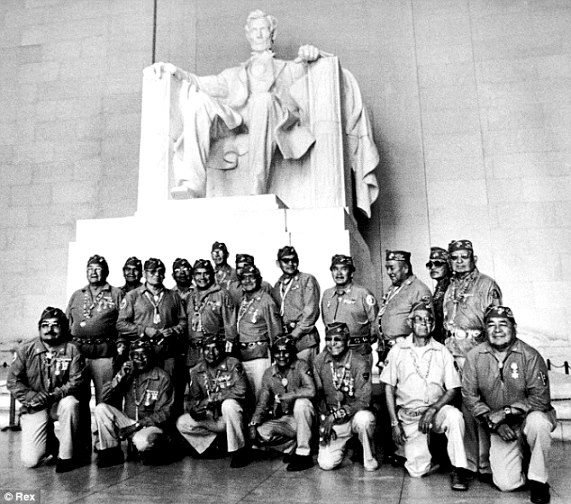
1989 – Bon Jovi’s New Jersey album becomes the first U.S. album to be released legally in the USSR; Russian label Melodiya paid the group with a truckload of firewood since it was illegal for rubles to leave Russia
1992 – Emergency airlifts of food to Somalia begin to ease drought and warfare crisis
2003 – A widespread power blackout affects northeastern U.S and Canada
2006 – Israel ends its offensive against Hezbollah guerrillas as a U.N.-imposed cease-fire goes into effect after a month of warfare that kills over 900 people
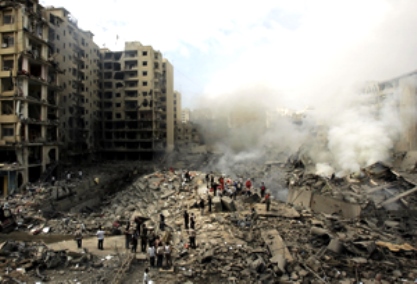
Hezbollah stronghold, Dahiyeh, a neighborhood of Beirut, after Israeli bombing
2015 – U.S. Embassy in Havana re-opens 54 years after diplomatic relations with Cuba were cut off
_________________________________________

 Nicole Plyler Fisk
 Gene Howington
 FFS Guest Blogger
 Joy of Fishes
 Chuck Stanley
 shortfinals
 Terry Welshans
 ann li-summers
 wordcloud9


 Flowers For Socrates