Good Morning!

______________________________
“There is a crack in everything, that’s how the light gets in.”
― Leonard Cohen
________________
“It is the responsibility, yet the individual choice,
of each of us to use the light we have to dispel
the work of darkness, because if we do not,
then the power of falsehood rises.”
— John Lewis, Across That Bridge
______________________________
13 poets born as the days
of December grow short,
and the nights darken.
______________________________
December 3
______________________________
1961 – Joe Bolton born in Cadiz, Kentucky; American poet; he started college on a baseball scholarship, but transferred to other schools: the University of Houston – where poet Edward Hirsh was his teacher – the University of Florida – where he studied with Pulitzer prize-winning poet Donald Justice – and finally the University of Arizona (UA). During that time, he published three poetry collections: Breckinridge County Suite; Days of Summer Gone; and The Last Nostaglia Poems.
The Light We Dance Through
by Joe Bolton
This is the afterlife. Her gin-
tinged breath came like a cool
injection in my ear.
We were dancing after midnight in this place
called 32nd Avenue, dancing
over cigarette butts & against
bodies not our own & through a light
of such blue density
it almost wasn’t light at all.
But outside, there were stars,
& though all around us the city was playing games
with its deranged souls,
we danced three times around the parking lot–
a waltz, for chrissake, a fucking
waltz. That
was 1981, & each year
there are fewer & fewer people I’ll admit
as my acquaintances,
& fewer still I’ll dance with,
& it’s probably the case
that, on those all-too-rare occasions,
the light we dance through is the closest
we’ll ever come to any sort of afterlife.
“The Light We Dance Through” from The Last Nostalgia: Poems 1982-1990, University of Arkansas Press 1999 edition
At the University of Arizona, Joe Bolton submitted his thesis for a Masters in Creative Writing in March 1990, then shot himself a few days later. He was 28 years old at the time of his death.
______________________________
December 4
______________________________
1875 – Rainer Maria Rilke born in Prague, Bohemia; Austrian-Swiss poet and author; one of the greatest of German-language poets. In 1902, he went to Paris to write a monograph on the sculptor Auguste Rodin, who had a great impact on Rilke, leading to Rilke’s much more modern poetic style. Rilke also admired Paul Cezanne. During WWI, he escaped military duty by working in the German War Record Office (1914-1916), then spent most of the rest of the war in Munich. From 1919 on, he spent much of his time Switzerland, increasingly at a sanatorium because of health problems which were eventually diagnosed as leukemia. He died in 1926 at age 51. Rilke is known for The Book of Hours; Duino Elegies; Sonnets to Orpheus; and Letters to a Young Poet.
A Walk
by Rainer Maria Rilke
My eyes already touch the sunny hill.
going far beyond the road I have begun,
So we are grasped by what we cannot grasp;
it has an inner light, even from a distance-
and changes us, even if we do not reach it,
into something else, which, hardly sensing it,
we already are; a gesture waves us on
answering our own wave…
but what we feel is the wind in our faces.
“A Walk” from Selected Poems of Rainer Maria Rilke, translated by Robert Bly – Harper Perennial, 1981 Bilingual Edition
______________________________
1927 – Anne George born in Montgomery, Alabama; American detective fiction writer and poet. Her Southern Sisters mystery series was honored with an Agatha Award, and her poetry collection Some of It is True was nominated for a Pulitzer Prize in 1993. She was the State Poet of Alabama in 1994, and a cofounder of Druid Press. She died at age 73 of complications during heart surgery in March 2001. Her poetry collections include Wild Goose Chase; Spraying Under the Bed for Wolves; and The Map that Lies Between Us.
Turned Funny
by Anne George
Southern women turn funny sometimes
when what the creek don’t drown
the locusts eat up, or the sun comes up
wrong side of the house. Good women,
turned funny, like my aunt Alma who,
leaving a pot of beans to burn,
did a mean can-can out in the yard
flipping her skirt over white cotton drawers
that nearly blinded a couple of truckers.
And southern families hold up their heads
straight as a church choir on Sunday.
When Mama turned funny,” they say proudly,
“She dived from the banisters, smashed
the zinnias.” Or “Judy sends postcards to Jesus.”
And now my family, God bless them, chime in.
“Our Anne,” they boast, “she writes poetry.”
“Turned Funny” from Some of It is True, © 1993 by Anne George – Curbow Publications
______________________________
1938 – Ken Smith born in Rudston, Yorkshire UK, the son of an itinerant farm laborer; prolific British poet, editor, teacher, and nonfiction writer. He attended Leeds University and studied with English poet and literary critic Geoffrey Hill, and was co-editor with Jon Silkin of Stand magazine (1963-1972). Smith won the 1964 Gregory Award for his first poetry collection, The Pity. He moved to the U.S. in 1969, to teach at Slippery Rock State College, College of the Holy Cross, and Clark University. He returned to England in 1973, to teach at his alma mater. Smith founded the South West Review literary magazine and was its editor (1971-1979). He won the 1997 Lannan Award for Poetry, and the 1998 Cholmondeley Award. Kent Smith died at age 64 in June 2003. His many poetry collections include: Grainy Pictures of the Rain; Burned Books; The poet reclining; A Book of Chinese Whispers; Wild Root; and You again: last poems & other words, published the year after his death.
The Window of Vulnerability
by Ken Smith
Sure today it could come in a fast plane
named perhaps for the pilot’s mother,
the city ends in a smear in the road
and that in a child’s shoe. No one
will say aboard the Missouri all these
proceedings are now closed, by nightfall
hours beyond zero no one remarks
it was grey, it had no beauty at all.
Now what to do with these postal districts
drifting downwind? It would be
routine enough on the autopilot,
flying home till there’s no home to fly to.
“The Window of Vulnerability” from Terra, © 1986 by Ken Smith – Bloodaxe Books
______________________________
December 5
______________________________
1856 – Alice Brown born in Hampton Falls, New Hampshire; prolific American novelist, playwright, and poet. She graduated from Robinson Female Seminary in 1876. She worked as a schoolteacher for five years, then moved to Boston in 1884. She worked at the Christian Register and the Youth’s Companion magazine. Her first novel, Fools of Nature, was published in 1887. She was a popular author for several years, but her popularity waned in the 20th century. Her only published poetry collection The Road to Castaly debuted in 1896, then was re-published with additional poems in 1917. She stopped writing in 1935, and died at age 91 in June 1948.
A Farewell
by Alice Brown
Thou wilt not look on me?
Ah, well! the world is wide;
The rivers still are rolling free,
Song and the sword abide;
And who sets forth to sail the sea
Shall follow with the tide.
Thrall of my darkling day,
I vassalage fulfil:
Seeking the myrtle and the bay,
(They thrive when hearts are chill!)
The straitness of the narrowing way,
The house where all is still.
“A Farewell” from The Road to Castaly, and Later Poems, by Alice Brown – Macmillan Company, 1917 edition
______________________________
December 6
______________________________
1957 – Myung Mi Kim born in Seoul, Korea; American poet and academic. Her family came to the U.S. when she was 9, and she grew up in the Midwest. After earning her MFA at the University of Iowa, she lectured on creative writing at San Francisco State University. She is now a Professor of English at the University of Buffalo. Her poetry collections include Under Flag; Civil Bound; Penury; Commons; and The Bounty.
LAMENTA: 423
by Myung Mi Kim
“peacekeeping troops”
“tanks beneath the windows”
The inside of someone else’s dwelling visible — a table and some chairs.
You start to count one, two, three, four . . . until the explosion is near your neighborhood.
You can guess the position of mortar by this counting and try to find a safe place.
If the windows are gone, weak plastic is taped up but the strong wind comes and we stay awake.
In this South Cholla Province where all vehicles had been confiscated, we resorted to walking, the method of travel of the Yi Dynasty. We reverted back 300 years.
. . . . . . . . . . . . . . . . . . . . . . . . . . . . . . . . Kwangju, 1980
It’s the same to be in the house, at the shelter or anywhere. There is no safe place.
When we have no electricity, we are sitting in the dark and we know what life looked like before Christ.
Sarajevo, 1992
“LAMENTA: 423” from Commons, © 2002 by Myung Mi Kim – University of California Press
______________________________
1962 – Julia Kasdorf born in Lewistown, Pennsylvania to a Mennonite family; American poet, essayist, editor, biographer, and Liberal Arts Professor of English at Penn State University. She has an MA in creative writing (poetry) and a PhD in English education. Her poetry collections include Eve’s Striptease; Sleeping Preacher, winner of the Agnes Lynch Starrett Poetry Prize; Poetry in America; and Shale Play: Poems and Photographs from the Fracking Fields. She has also published an essay collection, The Body and the Book: Writing from a Mennonite Life; a biography, Fixing Tradition: Joseph W. Yoder, Amish American; and co-edited Field Language: The Painting and Poetry of Warren and Jane Rohrer as well as Broken Land: Poems of Brooklyn.
What I Learned From My Mother
by Julia Kasdorf
I learned from my mother how to love
the living, to have plenty of vases on hand
in case you have to rush to the hospital
with peonies cut from the lawn, black ants
still stuck to the buds. I learned to save jars
large enough to hold fruit salad for a whole
grieving household, to cube home-canned pears
and peaches, to slice through maroon grape skins
and flick out the sexual seeds with a knife point.
I learned to attend viewings even if I didn’t know
the deceased, to press the moist hands
of the living, to look in their eyes and offer
sympathy, as though I understood loss even then.
I learned that whatever we say means nothing,
what anyone will remember is that we came.
I learned to believe I had the power to ease
awful pains materially like an angel.
Like a doctor, I learned to create
from another’s suffering my own usefulness, and once
you know how to do this, you can never refuse.
To every house you enter, you must offer
healing: a chocolate cake you baked yourself,
the blessing of your voice, your chaste touch.
“What I Learned From My Mother” from Sleeping Preacher, © 1992 by Julia Kasdorf – University of Pittsburgh Press
______________________________
1968 – Todd Boss born on a farm in the Chippewa Valley in Wisconsin; American producer, writer, public art installation artist, lyricist, inventor, and poet. His four poetry collections are Yellowrocket; Pitch; Tough Luck; and Someday the Plan of a Town.
The Hush of the Very Good
by Todd Boss
You can tell by how he lists
to let her
kiss him, that the getting, as he gets it,
is good.
It’s good in the sweetly salty,
deeply thirsty way that a sea-fogged
rain is good after a summer-long bout
of inland drought.
And you know it
when you see it, don’t you? How it
drenches what’s dry, how the having
of it quenches.
There is a grassy inlet
where your ocean meets your land, a slip
that needs a certain kind of vessel,
and
when that shapely skiff skims in at last,
trimmed bright, mast lightly flagging
left and right,
then the long, lush reeds
of your longing part, and soft against
the hull of that bent wood almost im-
perceptibly brushes a luscious hush
the heart heeds helplessly—
the hush
of the very good.
“The Hush of the Very Good,” © 2007 by Todd Boss, appeared in Poetry magazine’s February 2007 issue
______________________________
December 7
______________________________
1878 – Yosano Akiko born as Shō Hō, in Sakai, Osaka Prefecture, Japan; Japanese author, poet, pioneering feminist, and social reformer. Published in 1901, Midaregami (Tangled Hair), her first of several collections of tanka, a traditional Japanese poetry form, contained around 400 poems, the majority of them love poems. It was denounced by most literary critics as vulgar or obscene, but was widely read by freethinkers, as it brought a passionate individualism to this traditional form, unlike any other work of the late Meiji period. The poems defied Japanese society’s expectation of women to always be gentle, modest and passive. In her poems, women are assertively sexual. She frequently wrote for the all-woman literary magazine Seitō (Bluestocking.) Even though she gave birth to 13 children, 11 of whom survived to adulthood, she rejected motherhood as her main identity, saying limiting a sense of self to a single aspect of one’s life, however important, entraps women in the old way of thinking.
A tanka
by Yosano Akiko
Hair unbound, in this
Hothouse of lovemaking.
Perfumed with lilies,
I dread the oncoming of
The pale rose of the end of night.
– translation by Kenneth Roxroth
______________________________
1948 – Pearl Cleague born in Springfield, Massachusetts; African-American playwright, essayist, novelist, poet and political activist; as a Black feminist, political activist, and a writer, she tackles issues at the crux of racism and sexism. Her best-known novel is What Looks Like Crazy on an Ordinary Day, and her poetry collections are Dear Dark Faces: Portraits of a People, One for the Brothers, and We Speak Your Names: A Celebration. We Speak Your Names is a tribute to all the inspiring black women who came before.
This is: A Poem for Stacey Abrams
by Pearl Cleague
If freedom was a song, you came here singing.
If freedom was a bell, you came here ringing.
If freedom was a question, you know it’s time to ask it.
If freedom is a vote, you know it’s time to cast it.
And we will!
© 2020 by Pearl Cleague
______________________________
December 8
______________________________
1894 – James Thurber born in Columbus, Ohio; popular and prolific American humorist, author, cartoonist, journalist, and playwright; best known for his short stories and cartoons, many originally published in the New Yorker. He lost the sight in one eye in a childhood accident, and another injury later made him almost completely blind. He was unable to graduate from Ohio State University because of he couldn’t take the school’s mandatory ROTC course. He worked as code clerk (1918-1920) for U.S. Department of State, first in Washington DC, and then in the American embassy in Paris. He then became a reporter, critic and book reviewer with a weekly column called “Credos and Curios” for The Columbus Dispatch (1921-1924). In 1925, he moved to New York to work for the New York Evening Post, then joined the staff of the New Yorker. His career as a cartoonist began in 1930 when E.B. White found some of Thurber’s drawings in a trash can and submitted them. A number of his works have been turned into movies, including The Male Animal and The Secret Life of Walter Mitty. The Thurber Carnival was a Broadway revue directed by Burgess Meredith in 1960. Thurber died at age 66 from complications after surgery for a blood clot on the brain in November 1961.
Thurber may not have intended this as poetry, but I consider it a “found poem.”
The Way You Know It’s Thursday
by James Thurber
He wondered if he would kiss her and when he would kiss her
and if she wanted to be kissed and if she were thinking of it,
but she asked him what he would have to eat tonight at his hotel.
He said clam chowder. Thursday, he said,
they always have clam chowder.
Is that the way you know it’s Thursday, she said,
or is that the way you know it’s clam chowder?
“The Way You Know It’s Thursday” from The Works of James Thurber: Complete and unabridged – Longmeadow Press 1986 edition
______________________________
December 9
______________________________
1899 – Léonie Adams born in Brooklyn NY; American poet, editor, anthologist, children’s book author, and translator. Her family was very strict: she wasn’t allowed on the subway until she was 18, and only if accompanied by her father. Adams was the 7th Consultant in Poetry to the Library of Congress (1948-1949, now called U.S. Poet Laureate). Her roommate at Barnard College was Margaret Mead. Her poetry began being published in magazines while she was an undergraduate. Her first poetry collection, Those Not Elect, was published in 1925, while she was an editor at The Measure, a poetry journal. In 1928, she went to Europe, meeting literary figures such as H.D., Ezra Pound, and Gertrude Stein. She published four more poetry collections: High Falcon; Midsummer; This Measure; and Poems; A Selection, which won the 1954 Bollingen Prize. She was also honored with the 1955 Shelley Memorial Award by the Poetry Society of America. Adams died of heart disease at age 88 in June 1988.
The Figurehead
by Léonie Adams
This that is washed with weed and pebblestone
Curved once a dolphin’s length before the prow,
And I who read the land to which we bore
In its grave eyes, question my idol now,
What cold and marvelous fancy it may keep,
Since the salt terror swept us from our course,
Or if a wisdom later than the storm,
For old green ocean’s tinctured it so deep;
And with some reason to me on this strand
The waves, the ceremonial waves have come,
And stooped their barbaric heads, and all flung out
Their glittering arms before them, and are gone,
Leaving the murderous tribute lodged in sand.
“The Figurehead” from Poems: A Selection © 1954 by Léonie Adams – Funk & Wagnalls
______________________________
1917 – Samuel Washington Allen born in Columbus, Ohio, to the family of a clergyman; Black American lawyer, public servant, poet, professor, and translator. He sometimes used the pen name Paul Vesey. He studied with author and civil rights activist James Weldon Johnson at Fiske University, graduated as valedictorian, then earned a law degree from Harvard in 1941. After serving in the army during WWII, Allen was an NYC Assistant District Attorney, then did graduate work at the Sorbonne in Paris before becoming a civilian attorney with the U.S. armed forces in Europe. He next went into private practice in New York, then taught law at Texas Southern University. He was assistant general counsel of the U.S. Information Agency, then chief counsel of the Community Relations Service in Washington DC. He went back to teaching, first at Tuskegee Institute, then at Boston University. His poetry collections are Ivory Tusks and Other Poems; Paul Vesey’s Ledger; and Every Round and Other Poems. He died at age 97 in June 2015.
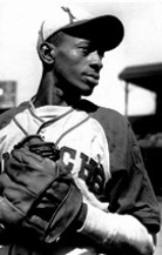
To Satch
by Samuel W. Allen
Sometimes I feel like I will never stop
Just go on forever
Till one fine mornin
I’m gonna reach up and grab me a handfulla stars
Swing out my long lean leg
And whip three hot strikes burnin down the heavens
And look over a God and say
How about that!!!!
“To Satch” from Every Round and Other Poems, © 1987 by Samuel Washington Allen – Broadside Lotus Press
______________________________

 Nicole Plyler Fisk
 Gene Howington
 FFS Guest Blogger
 Joy of Fishes
 Chuck Stanley
 shortfinals
 Terry Welshans
 ann li-summers
 wordcloud9


 Flowers For Socrates