Good Morning!

_______________________________
“Before a nation can be rebuilt, the citizens need to
understand how it was destroyed in the first place; how
its institutions were undermined, how the language
was twisted, how its people were manipulated.”
– Anne Applebaum, author of
Twilight of Democracy: The Seductive
Lure of Authoritarianism
________________
Maurice Lindsay, Scottish poet, at age 88
in 2006, when asked if he was a pacifist:
“No. I was in the army. Nevertheless, in my opinion,
the two worst inventions of mankind are religion and war.
Once you get certainties, once people become convinced that
they are right and only they are right and they’ll kill for it,
human beings reduce themselves to insignificance.
Although I’m temperamentally a happy person, at this point
in my life I’m a bit disillusioned with humanity. The way
that we carry on is pretty terrible.”
________________
______________________________
13 poets born this week,
who remember solitude,
how the smallest things
change our perceptions
(or blind us to reality),
and what’s in a name
______________________________
July 21
______________________________
1943 – Tess Gallagher born in Port Angeles, Washington, to a logging family; American poet, essayist, short story writer, and translator. She knew the landscapes of the Pacific Northwest and the Ozarks – home to her grandparents – very well from an early age. In 1977, she met Raymond Carver. He was a master of the short story, and inspired her to write three short story collections of her own. For 11 years they were friends, lovers, editors, and sounding boards. Carver became her third husband, and she his second wife, just six weeks before his death from lung cancer at age 50. Gallagher manages his literary estate. Her poetry collections include Under Stars, Amplitude, Moon Crossing Bridge (poems in remembrance of Raymond Carver), Midnight Lantern, and Is, Is Not Poems.
Now that I am Never Alone
by Tess Gallagher
In the bath I look up and see the brown moth
pressed like a pair of unpredictable lips
against the white wall. I heat up
the water, running as much hot in as I can stand.
These handfuls over my shoulder—how once
he pulled my head against his thigh and dipped
a rivulet down my neck of coldest water from the spring
we were drinking from. Beautiful mischief
that stills a moment so I can never look
back. Only now, brightest now, and the water
never hot enough to drive that shiver out.
But I remember solitude—no other
presence and each thing what it was. Not this raw
fluttering I make of you as you have made of me
your watch-fire, your killing light.
“Now that I am Never Alone” from Moon Crossing Bridge, © 1992 by Tess Gallagher – Graywolf Press
______________________________
1945 – Wendy Cope born in the Erith area of southeast London; English poet for both adults and children, journalist, and editor. She read history at St. Hilda’s College, Oxford, then worked for several years as a primary-school teacher. Her husband Lachlan Mackinnon is also a poet. Her poetry collections include Making Cocoa for Kingsley Amis, Anecdotal Evidence, Two Cures for Love, and Family Values. She has also edited several poetry anthologies.
Differences of Opinion
by Wendy Cope
1.
HE TELLS HER
He tells her that the earth is flat —
He knows the facts, and that is that.
In altercations fierce and long
She tries her best to prove him wrong.
But he has learned to argue well.
He calls her arguments unsound
And often asks her not to yell.
She cannot win. He stands his ground.
The planet goes on being round.
2.
YOUR MOTHER KNOWS
Your mother knows the earth’s a plane
And, challenged, sheds a martyr’s tear.
God give her strength to bear this pain –
A child who says the world’s a sphere!
Challenged, she sheds a martyr’s tear.
It’s bad to make your mother cry
By telling her the world’s a sphere.
It’s very bad to tell a lie.
It’s bad to make your mother cry.
It’s bad to think your mother odd.
It’s very bad to tell a lie.
All this has been ordained by God.
The world is round. That must be true.
She’s praying, hoping you will change.
Already people find you strange.
You know your anger is a sin.
You’re difficult. You don’t fit in.
God give her strength to bear this pain.
You know your anger is a sin.
Your mother knows the earth’s a plane.
“Differences of Opinion” was published in Poetry magazine’s February 2006 issue
______________________________
July 22
______________________________
1849 – Emma Lazarus, American poet, born in New York City, into a large and wealthy Sephardic Jewish family. Her mother was related to Supreme Court Justice Benjamin Cardozo. Lazarus, privately educated by tutors, studied American and British literature, and German, French, and Italian. In the 1880s, Lazarus was an advocate for Jewish refugees fleeing from Russian pogroms. Appalled by the refugees’ miserable living conditions, she volunteered at the Hebrew Immigrant Aid Society, and helped establish the Hebrew Technical Institute (1884-1939), a vocational high school. She wrote “The New Colossus” in 1883 for a fundraiser for the pedestal to support France’s gift of a statue for New York Harbor. She died in 1887, the year after “Liberty Enlightening the World” (the statue’s original title) was dedicated. Though her poem had been published in the New York Times, it was forgotten until 1901, when her friend Georgina Schuyler began a campaign for the poem to be memorialized. In 1903, the words were placed on the inner wall of the statue’s base, and changed forever the perception of the Lady with the Lamp.
The New Colossus
by Emma Lazarus
Not like the brazen giant of Greek fame,
With conquering limbs astride from land to land;
Here at our sea-washed, sunset gates shall stand
A mighty woman with a torch, whose flame
Is the imprisoned lightning, and her name
Mother of Exiles. From her beacon-hand
Glows world-wide welcome; her mild eyes command
The air-bridged harbor that twin cities frame.
“Keep, ancient lands, your storied pomp!” cries she
With silent lips. “Give me your tired, your poor,
Your huddled masses yearning to breathe free,
The wretched refuse of your teeming shore.
Send these, the homeless, tempest-tost to me,
I lift my lamp beside the golden door!”
______________________________
1939 ― Quincy Troupe, African-American poet, editor, journalist, UC San Diego professor emeritus, and children’s book author, born in St. Louis Missouri. The son of professional baseball player Quincy Thomas Trouppe. Known for his memoir Miles and Me; The Pursuit of Happyness, co-authored with Chris Gardner; The Architecture of Language, winner of the 2007 Paterson Award for Sustained Literary Achievement; and Transcircularities, which won the 2003 Milt Kessler Poetry Award. He was appointed in 2002 as California’s first poet laureate. His poetry collections include Avalanche, Skulls Along the River, and Snake-Back Solos.
Picking a Dandelion
by Quincy Troupe
for Joe and Jill Biden, Cheryl and Charles Ward, and for Margaret
walking along together
in the nation’s capital
Joe stopped, stooped, picked a flower—
a dandelion to be exact—
then he handed it to Jill—
who smiled in her white summer,
dress full of pretty flowers,
and someone snapped a picture
of this sweet, simple gesture,
it revealed something deeper,
profound, beautiful about
their love for each other here,
that taught all of us watching,
how to reach across time, space,
with a tender touch, a kiss
for one another here, now
in this moment of hatred
before time on earth runs out
“Picking a Dandelion” from Duende Poems, 1996-Now, ©2022 by Quincy Troupe – Seven Stories Press
______________________________
July 23
______________________________
1823 – Coventry Patmore born in Woodford, Essex, England; English poet and literary critic. He worked for the British Museum as a printed book supernumerary assistant (1846-1865). Patmore wrote poetry in his spare time, and published his first book in 1844, but its success was limited, and he was upset by harsh reviews. He didn’t publish his next book until 1853. The Angel in the House, a long narrative poem for which he is best remembered, was published in four parts between 1854 and 1863. It was a sentimental portrait of the Victorian ideal of Woman as wife and mother making a happy marriage. He was devastated when his wife Emily (who wrote three books under the pen name ‘Mrs. Motherly’), after giving birth to six children, died in 1862 at age 38, after a long decline from tuberculosis. Patmore married Marianne in 1864, but she died in 1880, and then he married Harriet, his children’s former governess, in 1881. Patmore died in 1896 at age 73.
Magna Est Veritas
(great is truth)
by Coventry Patmore
Here, in this little Bay,
Full of tumultuous life and great repose,
Where, twice a day,
The purposeless, gay ocean comes and goes,
Under high cliffs, and far from the huge town,
I sit me down.
For want of me the world’s course will not fail:
When all its work is done, the lie shall rot;
The truth is great, and shall prevail,
When none cares whether it prevail or not.
______________________________
1941 – Kim Jong-hae born in Busan, South Korea; Korean poet, sailor, and publisher. In his 20s, he was a ship’s crew member, which he later wrote about in his poetry collection Sailing Days, but his literary career began in 1963, when he won the Jayu Munhak New Writer’s Contest with his poem “Jeonyeok” (Evening). He was a founding member of the journal Sinnyeondae, and became secretary general of the Korean Poets’ Association, director of the Korean Publishing Culture Association, and co-founder with his brother of the publishing company Munhaksegyesa. His poetry collections include: Inganui akgi (The Musical Instrument of Humans); Sinui yeolsoe (Key of the Gods); Seourui jeongsin (The Spirit of Seoul); and Wae ani osinayo (Why Do You Not Come).
Snow
by Kim Jong-hae
Snowflakes are light,
for they carry each other on their backs.
The falling snow is comforting.
Watching the snowflakes rub their cheeks
upon one another’s backs is pleasing.
As the snow falls, I wish I could carry someone with me.
– translation © 2013 by Chae-Pyong Song and Anne Rashid, from Korean Poetry in Translation
______________________________
July 24
______________________________
1895 – Robert Graves born in Wimbledon, Surrey, England: British historical novelist, poet, critic, and classicist; best known for his novel, I, Claudius, which was adapted with its sequel, Claudius the God, by the BBC into the award-winning television series, I, Claudius. Graves is also notable for his translations of Classical Latin and Ancient Greek, and as a prolific poet who published nearly three dozen collections of poetry during his lifetime. He died at age 90 in December 1985.
Ouzo Unclouded
by Robert Graves
Here is ouzo (she said) to try you:
Better not drowned in water,
Better not chilled with ice,
Not sipped at thoughtfully
Nor toped in secret.
Drink it down (she said) unclouded
At a blow, this tall glass full,
But keep your eyes on mine
Like a true Arcadian acorn-eater.
“Ouzo Unclouded” from Robert Graves, The Complete Poems, © 2003 by Trustees of the Robert Graves Trust – Penguin Books
______________________________
1947 – Minou Drouet born in La Guerche-de-Bretagne, Brittany, France, as Marie-Noëlle Drouet; she had been almost blind at birth, and had to have a series of operations to recover her sight. By age eight, she could play Mozart on the piano. In 1955, some of her poems were privately circulated among French writers and publishers, causing controversy over whether they were written by the 8-year old Minou or by her foster mother. A test was set up. Minou was given the subject ‘Paris Sky’ and left alone in a room with only a pen and paper. Just 25 minutes later, she had completed her poem. Her first book of poems sold 40,000 copies, and she was lionized by Maurice Chevalier, Vittorio de Sica, Pablo Casals, and Jean Cocteau. By the time she was in her early 20s, she was married and leading a bohemian life on the Left Bank. But when her grandmother fell ill, she took care of her until her death. She decided to become a nurse, and cared for the elderly, terminally ill children, and pregnant women. By her early 30s, she was divorced and caring for her foster mother, diagnosed with Parkinson’s disease, back in her small home town in Brittany. She remarried, but has remained reclusive.
Paris Sky
by Minou Drouet
Paris sky, secret weight
flesh which in hiccups spits into our faces.
Through open jaws, the rows of houses
a stream of blood between its luminous teeth.
Paris sky, a cocktail of night and of fear that one savours with licks of the tongue
with little catches of the heart/ from the tip of a neon straw….
translator uncredited – this English-language version of “Paris Sky” appeared in LIFE magazine in 1956
______________________________
July 25
______________________________
1893 – Lexie Dean Robertson born in Lindale, Texas, but grew up in Canton Texas American teacher, Poet Laureate of Texas (1939-1931). She married a fellow student at North Texas State Normal College (today the University of North Texas), J. F. Robertson, in 1911. The couple settled in the small town of Rising Star in 1920. Robertson was the first native-born Texan to hold the position of Poet Laureate of Texas; her works was featured in magazines like Southwest Review, Good Housekeeping, and Ladies’ Home Journal. Robertson was a charter member of the Texas Institute of Letters, and also a member of both the Poetry Society of America and the Texas Federation of Women’s Clubs. Robertson was a Methodist and a democrat. She died at age 60 in February 1964. Her poetry collections include: Red Heels; I Keep a Rainbow; Acorn on the Roof; and Answer in the Night.
Gossip
by Lexie Dean Robertson
Before I knew how cruel
Just common talk can be,
I thought that words were singing things
With colors like the sea.
But since I’ve felt their caustic lash
And know how they can sting,
I hold my breath when words go by
For fear they will not sing.
“Gossip” by Lexie Dean Robertson, appeared at Poetry Explorer – www.poetryexplorer.net
______________________________
1951 – Angela Jackson born in Greenville, Mississippi, but grew up in a neighborhood on the South Side of Chicago; American poet, playwright, novelist, and academic. Raised as a Catholic, she went to St Anne’s elementary school, where she skipped 4th and 5th grade, then graduated third in her class at Loretto Academy, a Catholic girls high school, before going to Northwestern University on a pre-med studies scholarship. She joined the Organization of Black American Culture (OBAC), and became an editor of Nommo, OBAC’s literary journal, after deciding to switch from medicine to writing as a career. Her debut poetry collection, Voodoo Love Magic, was published in 1974. She served as a coordinator for OBAC (1976-1990). In 1977, Jackson graduated with a B.A. in English and American Literature from Northwestern, then earned an M.A. in Latin American and Caribbean studies at the University of Chicago in 1995. Much of her poetry focuses on social injustice. Among her many awards, she won a 1993 Carl Sandburg Award and a 2022 Ruth Lily Poetry Prize for her body of work from The Poetry Foundation. In 2020, she was named as poet laureate of the state of Illinois. Her poetry collections include: Dark Legs and Silk Kisses: The Beatitudes of the Spinners; It Seems Like a Mighty Long Time; and More Than Meat and Raiment.
The Love of Travelers
by Angela Jackson
At the rest stop on the way to Mississippi
We found the butterfly mired in the oil slick;
its wings thick and blunted. One of us, tender in the fingertips,
smoothed with a tissue the oil
that came off only a little;
the oil-smeared wings like lips colored with lipstick
blotted before a kiss.
So delicate the cleansing of the wings I thought the color soft as
watercolors
would wash off under the method of her mercy for something so slight
and graceful, injured, beyond the love of travelers.
It was torn then, even after her kindest work,
the almost-moth, exquisite charity could not mend
what weighted the wing, melded with it,
then ruptured it in release.
The body of the thing lifted out of its place
between the washed wings.
Imagine the agony of a self separated by gentlest repair.
“Should we kill it?” one of us said. And I said yes.
But none of us had the nerve.
We walked away, the last of the oil welding the butterfly
to the wood of the picnic table.
The wings stuck out and quivered when wind went by.
Whoever found it must have marveled at this.
And loved it for what it was and
had been.
I think, meticulous mercy is the work of travelers,
and leaving things as they are
punishment or reward.
I have died for the smallest things.
Nothing washes off.
“The Love of Travelers” from All These Roads Be Luminous: Poems Selected and New, © 1998 by Angela Jackson – TriQuarterly Books
______________________________
July 26
______________________________
1894 – Aldous Huxley born in Godalming, Surrey, England; English science fiction writer, novelist, poet, professor, and philosopher. He earned a degree in English literature from Balliol College, Oxford, where he edited the literary magazine Oxford Poetry. He wrote travel pieces, social satires, and screenplays, as well as philosophical works mysticism and pacifism, but is best known for his novel Brave New World. In 1937, he moved to Hollywood, and remained in the U.S. for the rest of his life. In 1939, his novel, After Many a Summer Dies the Swan, won the James Tait Black Memorial Prize. In 1960, Huxley was diagnosed with oral cancer, and died at age 69 in November 1963.
Points And Lines
by Aldous Huxley
Instants in the quiet, small sharp stars,
Pierce my spirit with a thrust whose speed
Baffles even the grasp of time.
Oh that I might reflect them
As swiftly, as keenly as they shine.
But I am a pool of waters, summer-still,
And the stars are mirrored across me;
Those stabbing points of the sky
Turned to a thread of shaken silver,
A long fine thread.
“Points and Lines” from The Defeat of Youth and Other Poems, by Aldous Huxley, originally published in 1918
______________________________
July 27
______________________________
1777 – Thomas Campbell born in Glasgow, Scotland, Scottish poet, biographer, lecturer, lyricist of patriotic war songs, translator, and one of the initiators of a plan to found London University, now University College London. His father became a successful tobacco merchant in Virginia in 1737, but lost his fortune because of the American Revolution. Thomas Campbell was educated at the High School of Glasgow and the University of Glasgow, where he won prizes in classics and verse-writing. By 1797, he was supporting himself by tutoring and writing, and attended lectures on law at the University of Edinburgh. In 1799, he published The Pleasures of Hope, a rhetorical and didactic poem which became popular. In 1800, he travelled to Germany, where he unfortunately arrived in Regensburg just three days before it was captured by the French, and he sought refuge in a monastery before getting out. He worked as a translator of foreign news for the Star, a London newspaper, and wrote narrative poems. He was editor of the New Monthly Magazine (1820-1830), and championed the Polish cause during the Polish-Russian War (1830-1831). Thomas Campbell died at age 66 in June 1844. His poetry collections include: Gertrude of Wyoming; Lochiel’s Warning; O’Connor’s Child; and Miscellaneous Poems.
Hope
by Thomas Campbell
At summer eve, when heaven’s aerial bow
Spans with bright arch the glittering hills below,
Why to yon mountain turns the musing eye,
Whose sunbright summit mingles with the sky?
Why do those cliffs of shadowy tint appear
More sweet than all the landscape smiling near? —
‘Tis distance lends enchantment to the view,
And robes the mountain in its azure hue.
______________________________
1870 – Hilaire Belloc born near Paris just a few days before the Franco-Prussian War began, Anglo-French writer, historian, poet, and social commentator. He was the son of a well-to-do French lawyer and an English mother, Elizabeth Rayner Parkes, who was a writer. The family fled to England in 1870 when news came of the French army’s collapse, returning after the war’s end to discover that their home had been looted and vandalized by Prussian soldiers. After his father died in 1872, and the family fortune was nearly wiped out in a stock-market crash, his mother brought her children back to England. Hilaire was sent to Cardinal Newman Catholic School in Hove. In 1892, he joined the French Artillery Service in France for a year. Returning to England, Belloc became a student at Baillol College, Oxford, and began writing for London newspapers and magazines. In 1896, his first book Verses and Sonnets appeared, followed by The Bad Child’s Book of Beasts, which satirized moralistic verse for children and became immensely popular. Belloc wrote in almost every form except drama, but his most enduring successes were in children’s poetry. He served as a Liberal Member of Parliament in the House of Commons while editor of the Morning Post. Later, he was editor of The Eye-Witness, a political weekly which attacked corruption and the political status quo, featuring contributions by George Bernard Shaw, H.G. Wells, and Belloc’s friend, G.K. Chesterton. Chesterton and Belloc, both devout Catholics, shared the view of Europe as a near-utopia under Church authority during the Middle Ages. Shaw caricatured them in print as “the Chesterbelloc” a beast of elephant-like appearance and outmoded beliefs. Belloc also wrote novels and histories. During World War I, he worked for the War Propaganda Bureau and as a correspondent on the Western front. Just a staunchly as he had opposed the Boer War, he now staunchly supported Britain’s involvement in this war, even though he lost many friends, and his son, who was killed in combat. In the years that followed WWI, he wrote a series of historical biographies and religious texts. In 1942 he suffered a stroke, which left him debilitated for the next eleven years, until his death on July 16, 1953, nine days before his 83rd birthday.
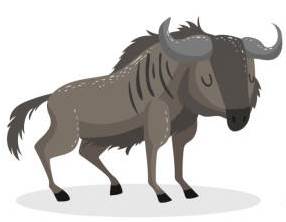
G Stands for GNU,
by Hilaire Belloc
whose weapons of Defence
Are long, sharp, curling Horns, and Common-sense.
To these he adds a Name so short and strong,
That even Hardy Boers pronounce it wrong.
How often on a bright Autumnal day
The Pious people of Pretoria say,
“Come, let us hunt the—” Then no more is heard
But Sounds of Strong Men struggling with a word.
Meanwhile, the distant Gnu with grateful eyes
Observes his opportunity, and flies.
MORAL:
Child, if you have a rummy kind of name,
Remember to be thankful for the same.
“G Stands for GNU” from More Beasts (For Worse Children), by Hilaire Belloc, originally published in 1897
______________________________

 Nicole Plyler Fisk
 Gene Howington
 FFS Guest Blogger
 Joy of Fishes
 Chuck Stanley
 shortfinals
 Terry Welshans
 ann li-summers
 wordcloud9


 Flowers For Socrates