
Good Morning!

_______________________________
“Poetry is a sort of homecoming.”
– Paul Celan,
Romanian-born French poet,
and holocaust survivor
________________
“What matters most is how well
you walk through the fire.”
– Charles Bukowski,
German-born American poet
________________
“August is nearly over – the month
of apples and falling stars …”
– Victor Nekrasov,
Soviet writer and journalist,
born in Ukraine
______________________________
13 poets born in August,
a sparse month for poets,
even words are muted by
a fevered sun – but those
who persist steal thunder
from the heavens, and
silence from the dead
______________________________
August 18
______________________________
1952 – Mwatabu S. Okantah born in Orange but raised in Vaux Hall, New Jersey as Wilbur Thomas Smith: African-American poet. He earned a B.A. in English and African Studies from Kent State, where he changed his name (Okantah means “breaker of rock” in the Ga language of Ghana), and an M.A. in creative writing from City College of New York. He is a professor and poet in residence in the Department of Pan-African Studies and director of a Ghana study abroad program at Kent State. His poetry collections include To Sing a Dark Song; Afreeka Brass; and Guerrilla Dread: Poetry for Hearts and Minds.
For Martin and Malcolm
by Mwatabu S. Okantah
i
resistance.
resist.
the legacy
is one of resistance.
resist
and reclaim our memories today.
ii
the ancestors wait
inside our silence.
they struggle for breath
inside stories
that refuse to be forgotten.
they cling to us,
the living diary of a tale
too few dare tell:
blackness.
creation. the Word.
Nummo.
darkness is the Mother of Light.
origins.
fire. water. earth. nature. mineral.
Eden.
Alkebulan.
outsiders
always called it Land of the Blacks.
Africa. Bilal al Sudan.
Abyssinia. Ethiopia.
they stood in wonder, in witness
to the Great Blackness.
our ancestors called it,
Ta-Seti,
“Land of the Bow,”
called it,
Kemet,
“The Black Land,”
we come from the navel of the earth.
“For Martin and Malcolm” from Muntu Kuntu Energy: New and Selected Poetry, © 2013 – Chatter House Press
______________________________
August 19
______________________________
1902 – Ogden Nash born in Rye, New York, American humorous light verse poet who wrote well over 500 poems, one of the best- known and liked U.S. poets. His family moved frequently because of his father’s import-export business. He spent a year at Harvard University in 1920, but dropped out, then taught briefly, tried to sell bonds in New York City, and then became a writer of streetcar card ads. He then worked as an editor at Doubleday Publishing. Nash submitted some of his short rhymes to The New Yorker, and editor Harold Ross asked him for more, “They are about the most original stuff we have had lately.” Nash spent three months in 1931 in working on the editorial staff for The New Yorker, and married Frances Leonard. They moved to Baltimore in 1934, where Nash died from complications of Crohn’s disease at age 68 in 1971.
Seaside Serenade
by Ogden Nash
It begins when you smell a funny smell,
And it isn’t vanilla or caramel,
And it isn’t forget-me-not or lilies,
Or new-mown hay, or daffy-down-dillies,
And it’s not what the barber rubs on Father,
And it’s awful, and yet you like it rather.
No, it’s not what the barber rubs on Daddy,
It’s more like an elderly finnan haddie,
Or, shall we say, an electric fan
Blowing over a sardine can.
It smells of seaweed, it smells of clams,
It’s as fishy as ready-made-telegrams,
It’s as fishy as millions of fishy fishes,
In spite of which you find it delishes,
You could do with a second helping, please,
And that, my dears is the ocean breeze.
“Summer Serenade” from The Best of Ogden Nash, © 2007 by Linell Nash Smith and the estate of Isabel Nash Eberstadt – Ivan R. Dee, Publisher
______________________________
1908 – Josephine Jacobsen born prematurely to her vacationing American parents in Cobourg, Ontario, Canada; American poet, short story writer, and nonfiction author. She has been honored with the Frost Medal, the Poets’ Prize, and the William Carlos Williams Award of the Poetry Society of America. After her father died when she was five, she and her mother traveled constantly. She was taught intermittently by private tutors, and became a voracious reader. Her first poem was published in St. Nicholas Magazine when she was 11. She was 14 when her mother settled them in New Jersey. Instead of going to college, she traveled, wrote, and acted with the Vagabond Players until her marriage in 1932 (which lasted until her husband’s death in 1995). Jacobsen’s first poetry collection, Let Each Man Remember, was published in 1940. She was Consultant in Poetry (1971-1973) to the Library of Congress (changed to U.S. Poet Laureate in 1985). In 1993, Jacobsen received the Shelley Memorial Award from the Poetry Society of America. In 1996, she won the Poet’s Prize for In the Crevice of Time. In 1997, Jacobsen was awarded the Robert Frost Medal for Lifetime Achievement in Poetry. Her 12 poetry collections include Sisters; Contents of a Minute; and The Chinese Insomniacs. She died at age 94 in 2003.
The Monosyllable
by Josephine Jacobsen
One day
she fell
in love with its
heft and speed.
Tough, lean,
fast as light
slow
as a cloud.
It took care
of rain, short
noon, long dark.
It had rough kin;
did not stall.
With it, she said,
I may,
if I can,
sleep; since I must,
die.
Some say,
rise.
“The Monosyllable” from In the Crevice of Time: New and Collected Poems, © 1995 by Josephine Jacobsen – John Hopkins University Press
______________________________
August 20
______________________________
1948 – Heather McHugh born in San Diego, California, to Canadian parents, but grew up in Gloucester Point, Virginia; American poet and translator. In Virginia, her father directed the marine biological laboratory on the York River. She became a freshman at Harvard at age 17. Her collection, Hinge & Sign: Poems 1968-1993, won the Bingham Poetry Prize of the Boston Book Review and was named by the New York Times Book Review as a Notable Book of the Year. Her other poetry collections include The Father of the Predicaments; Eyeshot; and Upgraded to Serious.
What He Thought
by Heather McHugh
– for Fabbio Doplicher*
We were supposed to do a job in Italy
and, full of our feeling for
ourselves (our sense of being
Poets from America) we went
from Rome to Fano, met
the mayor, mulled
a couple matters over (what’s
a cheap date, they asked us; what’s
flat drink). Among Italian literati
we could recognize our counterparts:
the academic, the apologist,
the arrogant, the amorous,
the brazen and the glib—and there was one
administrator (the conservative), in suit
of regulation gray, who like a good tour guide
with measured pace and uninflected tone narrated
sights and histories the hired van hauled us past.
Of all, he was the most politic and least poetic,
so it seemed. Our last few days in Rome
(when all but three of the New World Bards had flown)
I found a book of poems this
unprepossessing one had written: it was there
in the pensione room (a room he’d recommended)
where it must have been abandoned by
the German visitor (was there a bus of them?)
to whom he had inscribed and dated it a month before.
I couldn’t read Italian, either, so I put the book
back into the wardrobe’s dark. We last Americans
were due to leave tomorrow. For our parting evening then
our host chose something in a family restaurant, and there
we sat and chatted, sat and chewed,
till, sensible it was our last
big chance to be poetic, make
our mark, one of us asked
“What’s poetry?”
Is it the fruits and vegetables and
marketplace of Campo dei Fiori, or
the statue there?” Because I was
the glib one, I identified the answer
instantly, I didn’t have to think—”The truth
is both, it’s both,” I blurted out. But that
was easy. That was easiest to say. What followed
taught me something about difficulty,
for our underestimated host spoke out,
all of a sudden, with a rising passion, and he said:
The statue represents Giordano Bruno,
brought to be burned in the public square
because of his offense against
authority, which is to say
the Church. His crime was his belief
the universe does not revolve around
the human being: God is no
fixed point or central government, but rather is
poured in waves through all things. All things
move. “If God is not the soul itself, He is
the soul of the soul of the world.” Such was
his heresy. The day they brought him
forth to die, they feared he might
incite the crowd (the man was famous
for his eloquence). And so his captors
placed upon his face
an iron mask, in which
he could not speak. That’s
how they burned him. That is how
he died: without a word, in front
of everyone.
And poetry—
(we’d all
put down our forks by now, to listen to
the man in gray; he went on
softly)—
poetry is what
he thought, but did not say.
“What He Thought” from Hinge & Sign: Poems 1968-1993 © 1994 by Heather McHugh – Wesleyan University Press
* Fabbio Doplicher (1938-2003) was an Italian poet, performance artist, and literary critic. Doplicher’s poetry collection La rappresentazione (‘The Performance’) won the Premio Montale in 1985, and Compleanno del millennio (‘Birthday of the Millennium’) won the Premio Pellegrino in 2001. Some of his poetry has been translated, and published as Selected Poems, English translation by Gaetano A. Iannce, with a revision by Ruth Feldman
______________________________
August 21
______________________________
1926 – Carolyn Leigh born as Carolyn Rosenthal in the Bronx; American lyricist for Broadway, film, and pop music, partner of composer Cy Coleman; wrote lyrics for “The Best is Yet to Come,” and “Young at Heart,” “Hey Look Me Over” She and Dorothy Fields were the only prominent women lyricists of their day in a male-dominated field. “Witchcraft” was written by Leigh to music by Cy Coleman for Frank Sinatra, and was released as a single.
Witchcraft
Lyrics by Carolyn Leigh
Those fingers in my hair
That sly come-hither stare
That strips my conscience bare
It’s witchcraft
And I’ve got no defense for it
The heat is too intense for it
What good would common sense for it
Do?
(Chorus)
‘Cause it’s witchcraft, wicked witchcraft
And although I know it’s strictly taboo
When you arouse the need in me
My heart says “Yes, indeed” in me
“Proceed with what you’re leadin’ me to”
It’s such an ancient pitch
But one I wouldn’t switch
Cause there’s no nicer witch than you
© by Mpl Music Publishing/Downtown Dlj Songs
______________________________
1987 – Aja Monet born as Aja Monet Bacquie in Brooklyn, New York to parents of Cuban and Jamaican descent; American poet, writer, lyricist, and activist. At age 8, fascinated by storytelling and typewriters, she began writing poetry. She started performing her poems in high school. Encouraged by her teachers, Monet started a club, Students Acknowledging Black Achievements (SABA), and got involved with Urban Word NYC, which helped her see poetry could be a career. At 19, she won the title Nuyorican Poets Café Grand Slam Champion. Monet earned her BA from Sarah Lawrence College and MFA in writing from Art Institute of Chicago. She published two E-books, Black Unicorn Sings (2010) and Inner-City Chants and Cyborg Ciphers (2014). Her 2017 collection My Mother Was a Freedom Fighter was nominated for an NAACP Image Award for Outstanding Literary Work – Poetry. In 2015, she took part in founding Smoke Signals Studio, a social justice arts collective in Miami, and coordinated the poetry workshop VOICES: Poetry for the People. Monet is currently based in Los Angeles.
an offering
by Aja Monet
vermilion wax seeps soft
down a braided back of wick
the mischievous flame swallows
small devils rendered helpless
shadows tremor the parquet
how we rid a room of virulence
tug a cork from deep copper wine
and pour toward the mestizo priest hospitality defies sin, a spineless bruised
banana lay near
the lanterns gutter
we marooned in the projects
hid in the holy hood of our crown
douse our bodies in albahaca water blessed by sandhog saints
abre el camino
as hellish hipsters sip on Brooklyn brew we stopped and frisked spirits
haunt these streets
handcuffed with bicycles
while they litter their laughs
maraca our wrists at city hall
to thunder the gods from their tenement altars
venture to gentrify our heaven
and wage a war with a witch
“an offering” © 2020 by Aja Monet
______________________________
August 22
______________________________
1893 – Dorothy Parker born in Long Branch, New Jersey; American poet, wit, editor, and literary critic. Her formal education ended at age 14, but Parker was a founding member of the famed Algonquin Round Table (circa 1919-1929). When the New Yorker debuted in 1925, Dorothy Parker was on the editorial board. As the magazine’s “Constant Reader,” she contributed poetry, fiction — and book reviews famous for pulling no punches: “This is not a novel to be tossed aside lightly. It should be thrown with great force.” She made four failed suicide attempts, and said in an interview when she turned 70, “If I had any decency, I’d be dead. All my friends are.” In 1967, Parker did die, of a heart attack, at age 73. She bequeathed her literary estate to Dr. Martin Luther King, Jr., whom she had never met.
Testament
by Dorothy Parker
Oh, let it be a night of lyric rain
And singing breezes, when my bell is tolled.
I have so loved the rain that I would hold
Last in my ears its friendly, dim refrain.
I shall lie cool and quiet, who have lain
Fevered, and watched the book of day unfold.
Death will not see my flinch; the heart is bold
That pain has made incapable of pain.
Kinder the busy worms than ever love;
It will be peace to lie there, empty-eyed,
My bed made secret by the leveling showers,
My breast replenishing the weeds above.
And you will say of me, “Then has she died?
Perhaps I should have sent a spray of flowers.”
“Testament” from Dorothy Parker: Complete Poems – Penguin Classics (2010 edition)
______________________________
August 23
______________________________
1868 – Edgar Lee Masters born in Garnett, Kansas; American poet, novelist, and biographer; he rebelled against what he believed to be the hypocrisy of small-town life and went to Chicago, where he practiced law for thirty years. Masters published eleven books of verses, plays, and essays before beginning his masterpiece, Spoon River Anthology. He, Carl Sandburg, and Vachel Lindsay sparked a poetic renaissance in the Midwest, with Chicago as its center. He was awarded the Mark Twain Silver Medal in 1936, the Poetry Society of America medal in 1941, and the Shelly Memorial Award in 1944. He became a Fellow of the Academy of American Poets in 1942. Masters died in poverty in a nursing home at age 81.
Conrad Siever
by Edgar Lee Masters
Not in that wasted garden
Where bodies are drawn into grass
That feeds no flocks, and into evergreens
That bear no fruit —
There where along the shaded walks
Vain sighs are heard,
And vainer dreams are dreamed
Of close communion with departed souls —
But here under the apple tree
I loved and watched and pruned
With gnarled hands
In the long, long years;
Here under the roots of this northern-spy
To move in the chemic change and circle of life,
Into the soil and into the flesh of the tree,
And into the living epitaphs
Of redder apples!
“Conrad Siever” from Spoon River Anthology by Edgar Lee Masters
______________________________
1922 – Nazik Al-Malaika born in Bagdad, to a feminist poet mother and academic father; one of the most influential women poets in Iraq. She wrote her first poem at age 10. Al-Malaika graduated from the College of Arts in Baghdad in 1944, and later earned a Master’s degree in comparative literature at the University of Wisconsin-Madison. She was the first Arabic poet to use free verse, in her ground-breaking second book of poetry, Sparks and Ashes. Al-Malaika left Iraq in 1970 with her husband Abdel Hadi Mahbooba and their family, following the rise of the Baath Party to power. She died in Cairo, Egypt, in 2007 at the age of 83. Her other books of poetry include: And the sea changes its color; Bottom of the Wave; The Night’s Lover; and Revolt Against the Sun, which was edited and published posthumously.
Cholera
by Nazik al-Malaika
It is night.
Listen to the echoing wails
rising above the silence in the dark
…
the agonized, overflowing grief
clashing with the wails.
In every heart there is fire,
in every silent hut, sorrow,
and everywhere, a soul crying in the dark.
…
It is dawn.
Listen to the footsteps of the passerby,
in the silence of the dawn.
Listen, look at the mourning processions,
ten, twenty, no… countless.
…
Everywhere lies a corpse, mourned
without a eulogy or a moment of silence.
…
Humanity protests against the crimes of death.
…
Cholera is the vengeance of death.
…
Even the gravedigger has succumbed,
the muezzin is dead,
and who will eulogize the dead?
…
O Egypt, my heart is torn by the ravages of death.
– translated by Husain Haddawy, with Nathalie Handal
“Cholera” © by Nazik al-Malaila from The Poetry of Arab Women: A Contemporary Anthology, edited by Nathalie Handal – Interlink Books, 2001 edition
______________________________
1954 – Terry Wolverton born in Cocoa Beach, Florida, but grew up in Detroit, Michigan; American poet, novelist, and editor; earned a BA in Fine Arts from the University of Toronto. She also earned a certificate from the Feminist Studio Workshop at the Women’s Building in Los Angeles, and was instrumental in the Lesbian Art Project, and the Incest Awareness Project. She is known for her memoir, Insurgent Muse: Life and Art at the Woman’s Building. In 1997, she founded Writers at Work, where she teaches creative writing, and in 2007 co-founded The Future of Publishing Think Tank. Wolverton has won five Lambda Literary Awards, a Judy Grahn Award, and a Stonewall Literature Award. Her poetry collections include: Black Slip; Mystery Bruise; Shadow and Praise; and Blue Hunger.
Foster Care
by Terry Wolverton
Each house smells of strangers:
cabbage boiling on the stove,
harsh soap at the rim of the sink,
starched sheets that scrape
against the skin in bed,
hard pillows shaped
by someone else’s head,
rotting bananas, sweaty feet and dust.
Each time we come to a new place
I try to hide one shirt
beneath the mattress
just to keep the smell of home.
Sometimes they find it,
squeeze it through the wringer;
hid long enough, the cloth absorbs
the air around it, loses its memories.
My brother smells like sour milk,
unwashed armpits and the school paste
he eats. He cries
when they hit us; I never do.
Each night I hear
his sniffles soak the pillow.
Come morning, I grab the damp case,
hold it to my nose and breathe.
“Foster Care” from Embers, © 2003 by Terry Wolverton – Red Hen Press
______________________________
1974 – Michelle McGrane South African poet born in Zimbabwe, who spent her childhood in Malawi, until her family moved to Pietermaritzburg, South Africa in 1988; her poetry collections include Fireflies & Blazing Stars and Hybrid. She has been a mentor in the Agenda Feminist Media Project Creative Writing Programme. In 2004, she participated in the Centre for the Book’s Turning the Page Festival in Cape Town.
Things that a Bond Girl should never leave home without
by Michelle McGrane
A double entendre,
a steady gun-arm, a failproof
recipe for Béarnaise sauce,
a kick-ass lipstick,
‘Five of a Kind’.
Contortionist training,
a reservation at Maxim’s,
a magnum of Taittinger Blanc
de Brut 1943 and twenty
Morland Specials.
A stolen copy
of Hogan’s Power Golf,
a smouldering silhouette,
a commando dagger,
a cyanide tablet.
Sagittarius rising,
a Côte d’Azur suntan,
opera glasses, life insurance,
fifty rounds of ammo,
a contact in Japan.
A bluff and a bikini,
a Triumph convertible,
a parachute, a silk peignoir,
a concealed blueprint,
an escape route.
“Things that a Bond Girl should never leave home without” from The Suitable Girl, © 2010 by Michelle McGrane – Pindrop Press
______________________________
August 24
______________________________
1591 – Robert Herrick baptized on August 24, 1591, in London; English lyric poet and Anglican cleric known for his poetry collection, Hesperides, which includes “To the Virgins, to Make Much of Time,” with the opening line “Gather ye rosebuds while ye may.” He was dismissed as a minor poet, until 20th century scholars began to reevaluate his work. His father, a goldsmith, died when Herrick was an infant. He was apprenticed at 16 to his uncle, also a goldsmith, but left at age 22, and went to Saint John’s College, Cambridge. Limited means forced him to transfer the less expensive Trinity Hall. He took holy orders in 1623, but little else is known about his life from 1617 until 1629, when he was appointed as vicar of Dean Prior in Devonshire. A Royalist during the English Civil War, he was expelled from his parish in 1647 for refusing the Solemn League and Covenant. During his exile, he lived in London on the charity of his friends and family until the monarchy was restored. Herrick returned to his parrish in 1662, where he died at age 83 in 1674.
The Coming of Good Luck
by Robert Herrick
So Good-Luck came, and on my roof did light,
Like noiseless snow, or as the dew of night;
Not all at once, but gently,—as the trees
Are by the sun-beams, tickled by degrees.
______________________________
1898 – Malcolm Cowley born in Pennsylvania; American novelist, poet, historian, and critic; an ex-pat American who lived in Paris in the 1920s, which he wrote about in his memoir Exile’s Return (1934). In 1929, his first book of poetry Blue Juniata was published, and he became an associate editor of the left-leaning New Republic. He was involved in leftist politics in the 1920s and 30s. In 1941, when President Franklin Roosevelt appointed Cowley’s friend Archibald MacLeish as head of the War Department’s Office of Facts and Figures, MacLeish recruited Cowley as an analyst, but Cowley soon ran afoul of the House Un-American Activities Committee. MacLeish was pressured by J. Edgar Hoover and the Federal Bureau of Investigation to dismiss Cowley. In January 1942, MacLeish sent his reply that the FBI needed a course of instruction in history. “Don’t you think it would be a good thing if all investigators could be made to understand that Liberalism is not only not a crime but actually the attitude of the President of the United States and the greater part of his Administration?” he wrote. Cowley resigned two months later. In 1944, Cowley began a new career as a literary advisor, editor, and talent scout at Viking Press. He worked on the Portable Library series, an anthology of paperback reprints that could be mass-produced cheaply and marketed to military personnel. His first project was The Portable Hemingway, which sold so well, he followed it with The Portable Faulkner, which rescued Faulkner from falling into literary obscurity. He pushed for publication of Jack Kerouac’s On the Road, edited an anthology of F. Scott Fitzgerald’s short stories, and oversaw a reissue of Tender Is the Night. His memoir, The View From 80, was published in 1980. He died at age 90 in 1989.
The Firstborn
by Malcolm Cowley
What can I offer you now, now?
Heavy the years pour over me. How
give you the freight of them,
spare you the weight of them?
What have I learned for you here, here?
What have I saved for you, made for you? Where
the word to pass on to you
with my blood gone to you?
Only the rain beating now and the trees dim in the air.
“The Firstborn” from Blue Juniata: Collected Poems, © 1968 by Malcolm Cowley – Viking Press
______________________________
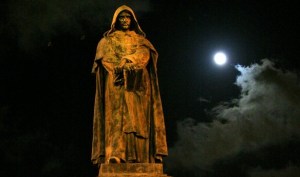
statue of Giordano Bruno

 Nicole Plyler Fisk
 Gene Howington
 FFS Guest Blogger
 Joy of Fishes
 Chuck Stanley
 shortfinals
 Terry Welshans
 ann li-summers
 wordcloud9


 Flowers For Socrates