Good Morning!

_______________________________
“Nothing endures but change.”
— Heraclitus
________________
“who will join this standing up …
we are the ones we have been waiting for”
— June Jordan, from “Poem
for South African Women”
________________
Because things are the way they are,
things will not stay the way they are.
— Bertolt Brecht
____________________________
13 poets born in October,
writing of change or
transformation,
acceptance
or dissent.
____________________________
October 13
____________________________
1896 – Arna Bontemps born in Alexandria, Louisiana, to a Creole family; American poet, novelist, and librarian, notable figure in the Harlem Renaissance. The Bontemps family moved to Los Angeles when Arna was three years old, and settled in the Watts district. After graduating from college in 1923, he worked for the post office, until he moved to New York in 1924.
A Black Man Talks of Reaping
by Arna Wendell Bontemps
I have sown beside all waters in my day.
I planted deep, within my heart the fear
that wind or fowl would take the grain away.
I planted safe against this stark, lean year.
I scattered seed enough to plant the land
in rows from Canada to Mexico
but for my reaping only what the hand
can hold at once is all that I can show.
Yet what I sowed and what the orchard yields
my brother’s sons are gathering stalk and root;
small wonder then my children glean in fields
they have not sown, and feed on bitter fruit.
“A Black Man Talks of Reaping” from American Poetry: The Twentieth Century, Volume 2; © 1926 by Arna Bontemps – Library of America
____________________________
October 14
____________________________
1867 – Masaoka Shiki born as Masaoka Noboru on Japan’s Shikoku Island; Japanese poet, author, and literary critic during the Meiji period. One of the four great haiku masters, along with Matsuo Bashō, Yosa Buson, and Kobayashi Issa. He died of tuberculosis at age 34 in 1902.
Two Haiku by Masaoka Shiki:
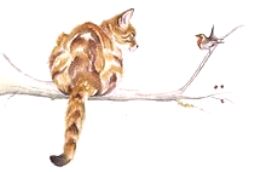
a fancy-free cat
is about to catch
a quail
autumn is leaving
tugging each others’ branches
two pine trees
Masaoka Shiki: Selected Poems, translation © 1998 by Burton Watson – Columbia University Press
______________________________
October 14, 1949 – Katha Pollitt born in Brooklyn, New York, American essayist poet, critic, and feminist. She writes a bimonthly column, “Subject to Debate,” for The Nation magazine, and is the author of four essay collections and two books of poetry. She was The Frost Place poet-in-residence in 1977, and her poetry collection Antarctic Traveller won the 1983 National Book Critics Circle Award. Her 2014 nonfiction book, Pro: Reclaiming Abortion Rights is an unapologetic and wholehearted defense
of abortion as a moral right and force for social good.
Two Cats
by Katha Pollitt
It’s better to be a cat than to be a human.
Not because of their much-noted grace and beauty—
their beauty wins them no added pleasure, grace is
only a cat’s way
of getting without fuss from one place to another—
but because they see things as they are. Cats never mistake a
saucer of milk for a declaration of passion
or the crook of your knees for
a permanent address. Observing two cats on a sunporch,
you might think of them as a pair of Florentine bravoes
awaiting through slitted eyes the least lapse of attention—
then slash! the stiletto
or alternately as a long-married couple, who hardly
notice each other but find it somehow a comfort
sharing the couch, the evening news, the cocoa.
Both these ideas
are wrong. Two cats together are like two strangers
cast up by different storms on the same desert island
who manage to guard, despite the utter absence
of privacy, chocolate,
useful domestic articles, reading material,
their separate solitudes. They would not dream of
telling each other their dreams, or the plots of old movies,
or inventing a bookful
of coconut recipes. Where we would long ago have
frantically shredded our underwear into signal
flags and be dancing obscenely about on the shore in
a desperate frenzy,
they merely shift on their haunches, calm as two stoics
weighing the probable odds of the soul’s immortality,
as if to say, if a ship should happen along we’ll
be rescued. If not, not.
“Two Cats” from The Mind-Body Problem, © 2009 by Katha Pollitt – Random House
______________________________
1988 – Ocean Vuong born as Vuong Quốc Vinh in Ho Chi Minh City, Vietnam; Vietnamese American poet, essayist, and novelist. His grandfather was a white American serving during the Vietnam War, who met and married a Vietnamese girl. They had three children, including Vuong’s mother. In 1975, his grandfather, on a visit to the U.S., was cut off from the family when Saigon fell to communist forces. His grandmother separated her daughters into orphanages, concerned for their survival. When Ocean was two, the family fled Vietnam after a police officer became suspicious that his mother was part white, and subject to the regime’s discriminatory policies. They eventually reached a refugee camp in the Philippines, then gained asylum and migrated to the U.S., settling in Hartford, Connecticut. His mother renamed him Ocean after they came to America. His father abandoned the family, but Vuong later found his American grandfather. At age 11, he was the first child in his family to learn to read. By 15, he was working on a tobacco farm illegally, which he wrote about in his 2019 debut novel On Earth We’re Briefly Gorgeous. After struggling in school, he tried community college, then enrolled as a marketing major, but quickly decided it wasn’t for him. He earned a BA in English at Brooklyn College, City University of New York, then an MFA in poetry at New York University. Among his many awards, he has won the Stanley Kunitz Prize for Younger Poets, the T.S. Eliot Prize, and was short-listed for the Dylan Thomas Prize for On Earth We’re Briefly Gorgeous. His poetry collections include Burnings; Night Sky with Exit Wounds; and Time is a Mother.
Torso of Air
by Ocean Vuong
Suppose you do change your life.
& the body is more than
a portion of night––sealed
with bruises. Suppose you woke
& found your shadow replaced
by a black wolf. The boy, beautiful
& gone. So you take the knife to the wall
instead. You carve & carve
until a coin of light appears
& you get to look in, at last,
on happiness. The eye
staring back from the other side––
waiting.
“Torso of Air” from Night Sky with Exit Wounds, © 2016 by Ocean Vuong – Copper Canyon Press
____________________________
October 15
____________________________
1830 – Helen Hunt Jackson born in Amherst, Massachusetts, daughter of a Unitarian minister and professor at Amherst College; American author, poet and activist for improved treatment of Native Americans by U.S. Government. Her mother died when Helen was 14, then her father died three years later, but he had provided for her education, and her uncle acted as her guardian. In 1852, she married U.S. Army Captain Edward Hunt, but he died in an accident in 1863. Her poetry under pen names began appearing in magazines like The Atlantic and The Nation in 1869, and she traveled in both Europe and the Western U.S. She met her second husband, banker William Jackson, in Colorado Springs, and they were married in 1875. She also published three novels anonymously between 1876 and 1878. But after she attended lecture in Boston given by Chief Standing Bear of the Ponca tribe, she began investigating and publicizing government misconduct, circulating petitions, raising money, and writing letters to The New York Times on behalf of the Ponca, exposing the government’s violation of treaties with American Indian tribes. She documented the corruption of U.S. Indian agents, military officers, and settlers who encroached on and stole reserved Indian lands, and her reports began to published in several newspapers and magazines. Though she sometimes failed to properly document her accusations, enough of what she claimed was provable, and helped bring attention to the plight of Indian tribes across the U.S. Her first book published under her own name, A Century of Dishonor, recounted the long history of treaties broken by the U.S. government. A trip to California led to her exposing the plight of the “Mission Indians” after California was taken over by the U.S. From an estimated population in 1852 of 15,000, their populations had declined to less than 4,000. The U.S. Commissioner of Indian Affairs, Hiram Price, recommended her appointment as an Interior Department agent, and she was assigned to investigate the conditions of the “Mission Indians.” She traveled with fellow agent Abbot Kinney all over Southern California, and she reported their findings. A bill to implement her report’s recommendations passed the Senate, but failed in the House. This inspired her to write her best-selling novel Ramona, published in 1884. Helen Hunt Jackson died at age 54 of stomach cancer in August 1885. A collection of her poetry, her book A Century of Dishonor, and Ramona are still in print.
October
by Helen Hunt Jackson
Bending above the spicy woods which blaze,
Arch skies so blue they flash, and hold the sun
Immeasurably far; the waters run
Too slow, so freighted are the river-ways
With gold of elms and birches from the maze
Of forests. Chestnuts, clicking one by one,
Escape from satin burs; her fringes done,
The gentian spreads them out in sunny days,
And, like late revelers at dawn, the chance
Of one sweet, mad, last hour, all things assail,
And conquering, flush and spin; while, to enhance
The spell, by sunset door, wrapped in a veil
Of red and purple mists, the summer, pale,
Steals back alone for one more song and dance.
____________________________
October 16
____________________________
1854 – Oscar Wilde born in Dublin Ireland; Irish playwright, author, and poet; noted for plays like The Importance of Being Earnest and Lady Windermere’s Fan; his novel, The Picture of Dorian Gray and his poem, The Ballad of Reading Gaol. He was tried and convicted of “gross indecency” with other males, and ultimately sentenced to two years’ hard labour, and served his sentence from 1895 to 1897. On the day he was released, he took the overnight steamer to France, and never returned to the British Isles. He died at age 46 in Paris in November 1900.
Sonnet to Liberty
by Oscar Wilde
Not that I love thy children, whose dull eyes
See nothing save their own unlovely woe,
Whose minds know nothing, nothing care to know,—
But that the roar of thy Democracies,
Thy reigns of Terror, thy great Anarchies,
Mirror my wildest passions like the sea
And give my rage a brother—! Liberty!
For this sake only do thy dissonant cries
Delight my discreet soul, else might all kings
By bloody knout or treacherous cannonades
Rob nations of their rights inviolate
And I remain unmoved—and yet, and yet,
These Christs that die upon the barricades,
God knows it I am with them, in some things.
____________________________
October 17
____________________________
1937 – Mary Ann Taylor-Hall born in Chicago, Illinois, but the family moved to Winterhaven, Florida when she was nine; American poet, novelist, and short story writer. She also taught at several universities, including Auburn, University of Puerto Rico, and Miami University of Ohio. She lived on a farm in Kentucky for many years, with her husband and fellow poet and novelist James Baker Hall, who died in 2009. She was also a co-editor of Missing Mountains, an anthology of Kentucky writers opposed to mountaintop removal coal mining. Taylor-Hall’s poetry collections are: Dividing Ridge; Joy Dogs; and Out of Nowhere: New and Selected Poems.
Nothing But Alive
by Mary Ann Taylor-Hall
We are, each one, alone—this is not news,
and neither is it news that sometimes we break free.
Our spirits slide into the clear black sky of stars
and (perhaps obscured by clouds) the moon,
rolling through its phases above our circumstantial bodies,
with their outrageous stories and long bones and birthmarks
and honest, crazy loves and tendencies
toward every sort of breakdown.
We see it all from up there, for a moment, everything
that holds us to our lives, with a force like gravity.
And we’re, for a moment, not held. Floating free.
Nothing but alive.
But we’ve come to love our fragile cloister.
We fear to lose its homey beauty, its eccentric rooms,
its constancy and shelter. We go back down to it.
We settle in.
“Nothing But Alive” from Out of Nowhere: New and Selected Poems, © 2017 by Mary Ann Taylor-Hall – Old Cove Press
______________________________
1942 – Duane Ackerson born in New York City; American author of speculative fiction and poetry. He was Director of Creative Writing at Idaho State University. His published works include The Eggplant & Other Absurdities; Weathering; UA Flight to Chicago; and the textbook Writing Poetry. He died at age 77 in April 2020.
Weathering
by Duane Ackerson
You told us about chairs
made for out of doors,
rough-hewn and left outside
so the joints could fill and grow
together in the rain.
These chairs could last fifty years
on the front porch, you said,
and fall apart
with a year of the parlor.
Watching you at dinner,
tan face, knotted arms,
your wife pale as fresh cut timber,
I could see you knew
what sort of carpentry
you were.
“Weathering” from Weathering, © 1973 by Duane Ackerson – West Coast Poetry Review
______________________________
1965 – Anna Leahy born in Illinois, daughter of attorney Mary Lee Leahy; Anna Leahy is an American poet, nonfiction writer, editor, and academic. Her first full-length poetry collection, Constituents of Matter, won Kent States’ Wick Poetry Prize in 2006. She has also won top prizes for her essays. She and her husband Douglas R. Dechow co-founded the blog Lofty Ambitions (2010-2017), about aviation and space. Leahy directs the Tabula Poetica Center for Poetry and MFA in Creative Writing program at Chapman University in Orange, California. In 2013, she was named editor of TAB: The Journal of Poetry & Poetics. She has also edited and co-authored books about teaching creative writing. Her poetry collections include: Turns About a Point; Sharp Miracle; and If in Some Cataclysm.
World of Glass
by Anna Leahy
Birds do not look much like leaves
until fluttering leaves look, to me, like birds
because feathering is a metaphor.
Shearings are slivers trimmed from glass
and shearlings are sheep just shorn. The meaning
is in the action, not in the thing itself.
It’s the throwing of the stone. The chip
makes a waster or cullet, something flawed,
returned to potential, so different
than flight. To leaf is to layer
in gold. Pages are leafed through, and feather
meant flying before it became pen,
just as glass was sand before it was glass.
Sheets can be paper, or they can be glass.
An eye can be glass, can glass over, and plume
is the shape of smoke, of birds, as if etched
on air. When the atmosphere cracks,
glass is said to weep. No fleece, no feather or leaf,
no view through the fire and glaze. Flamework
gives shape to sand. The birds take their leave.
“World of Glass” © 2020 by Anna Leahy, appeared in Poetry magazine’s December 2020 issue
____________________________
October 18
____________________________
1587 – Lady Mary Wroth born English Renaissance poet, one of the first women to achieve an enduring reputation in literature; author of Urania, the first known, still surviving prose romance written by an English woman, the sonnet sequence Pamphilia to Amphilanthus, and Love’s Victory, a pastoral closet drama (reader’s theatre piece for private performance). Her writing became an escape from her marriage to a drunkard and gambler whose death left her deeply in debt. The rest of her life was filled with financial uncertainty, and scandal over a long-enduring love affair which ended badly. A storm of criticism of her epic and somewhat autobiographical novel, The Countess of Montgomery’s Urania, kept it from being republished in her lifetime, because of its political content and its questioning of the conventional restrictions placed on women. Only the year of her death, 1652, is now known – the day of it passed unmarked.
Sonnet 35
by Lady Mary Wroth
False hope, which feeds but to destroy, and spill
What it first breeds, unnatural to the birth
Of thine own womb; conceiving but to kill,
And plenty gives to make the greater dearth,
So Tyrants do who falsely ruling earth
Outwardly grace them, and with profits fill
Advance those who appointed are to death
To make their greater fall to please their will.
Thus shadow they their wicked vile intent
Colouring evil with a show of good
While in fair shows their malice so is spent;
Hope kills the heart, and Tyrants shed the blood.
For hope deluding brings us to the pride
Of our desires the farther down to slide.
“Sonnet 35” from The Poems of Lady Mary Wroth, edited by Josephine A. Roberts – Louisiana State University – 1992 edition
______________________________
1948 – Ntozake Shange born as Paulette Linda Williams in Trenton, New Jersey; American playwright, poet, novelist, and Black feminist. Her ground-breaking play, for colored girls who have considered suicide / when the rainbow is enuf, which she called a choreopoem, was first performed in 1974, in a women’s bar in Northern California. Shange moved to New York, and the play continued evolving, winning an Obie Award before it opened at the Booth Theatre in September 1976, only the second play by a Black woman to reach Broadway, after Lorraine Hansberry’s A Raisin in the Sun in 1959. It was nominated for a Tony Award for Best Play. She wrote five novels, including Sassafrass, Cypress & Indigo and Betsy Brown. Her poetry collections include Nappy Edges; Some Men; “Enuf’; Wild Beauty; and Freedom’s a-Callin Me. Shange suffered a series of strokes in 2004, and died at age 70 in October 2018.
we need a god who bleeds now
by Ntozake Shange
we need a god who bleeds now
a god whose wounds are not
some small male vengeance
some pitiful concession to humility
a desert swept with dryin marrow in honor of the lord
we need a god who bleeds
spreads her lunar vulva & showers us in shades of scarlet
thick & warm like the breath of her
our mothers tearing to let us in
this place breaks open
like our mothers bleeding
the planet is heaving mourning our ignorance
the moon tugs the seas
to hold her/ to hold her
embrace swelling hills/ i am
not wounded i am bleeding to life
we need a god who bleeds now
whose wounds are not the end of anything
― From a daughter’s geography
“we need a god who bleeds now” from Wild Beauty: New and Selected Poems, © 2017 by Ntozake Shange – Simon & Schuster Paperbacks
____________________________
October 19
____________________________
1879 – Emma Bell Miles born in Evansville, Indiana; her parents were teachers, and she spent her childhood in small towns in Kentucky, Ohio, and Tennesssee; American short story writer, poet, and artist. She published The Spirit of the Mountains in 1905, which contained stories, travels narratives, memoir, and cultural analysis of Southern Appalachia. A section of her book on Appalachian music, which first appeared as an article in Harper’s Monthly in 1904, was probably the first on the subject printed in a popular magazine. Her journals have also appeared in print.
Music and Fire
by Emma Bell Miles
The night is long, the day was short.
The black frost locks our world;
Against our cabin’s lowly roof
The wind’s keen hate is hurled.
The stark pines’ harp-string hum resounds
Through all the glittering night;
But here the fiddle’s song is higher,
And louder roars our hickory fire,
And brighter gleams its light.
What though our bread is coarse and scant,
Or bare and rude our walls?
Look where on smoky log or chink
The scarlet splendor falls.
Hark to the banjo’s merry din!
So must our souls be fed:
For we, however poor, can yet
The hungry winter’s woes forget,
For music barter bread.
“Music and Fire” from Strains from a Dulcimore, by Emma Bell Miles, published in 1930 by The Bozart Press
______________________________
1996 – Anna Leader born in Bellingham, Washington; Luxembourger poet and novelist who writes in English; daughter of 2 schoolteachers, who moved the family to Luxembourg in 2000 when Anna was four. Leader won the first prize at the ‘Concours Jeune Printemps’ in 2012 for her poem “Elegy for Two.” Her poetry collection Squeak Like Dolls, and her debut novel Tentative were both published in 2013. She won the Luxembourgish Concours littéraire national in 2014, for her historical novel A Several World; again in 2015, for her poetry collection A Lifetime Lies; and a third time in 2018 for her play Outlast.
a cat talks about cat-poetry
by Anna Leader
“contrary to popular belief, we do read
what’s written about us, and we do take heed
(not only to know what is said—we get bored):
that fellow baudelaire for example we adored,
he understood our “mystique” and how we keep
aspiring to be sphinxes in our sleep.
we liked eliot, too, although he poked fun—
(those names, those rhymes, those puns!
and the sellout to the west end. rather cheap.)
the bit in prufrock, admittedly, was dear
when he talked about the evening, and the fog.
& let’s not mention that nonsense by that edward lear!
(as if a cat and an owl were a compatible pair!
he may as well have married pussy off to a dog.)”
“a cat talks about cat-poetry” © by Anna Leader, is featured on Poems, The Poetry Society website
____________________________

 Nicole Plyler Fisk
 Gene Howington
 FFS Guest Blogger
 Joy of Fishes
 Chuck Stanley
 shortfinals
 Terry Welshans
 ann li-summers
 wordcloud9


 Flowers For Socrates