
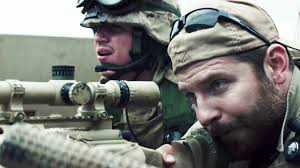
American Sniper
By Elaine Magliaro
We have already discussed Clint Eastwood’s hit movie American Sniper at FFS on the following posts: Hollywood and War: “American Sniper”…a Movie about a Killer Hero and Propaganda 102 Supplemental: Holly Would “American Sniper.” The pro/con debate about this popular war movie, which is based on Chris Kyle’s memoir, continues. In the past week, I came across two more interesting articles on the subject of American Sniper and the kinds of war movies being made today.
One of the articles is titled Hollywood Heroism in the Age of Empire: From “Citizenfour” and “Selma” to “American Sniper.” It was written by Canadian author Henry A. Giroux. Giroux’s most recent books include: Youth in Revolt: Reclaiming a Democratic Future, America’s Educational Deficit and the War on Youth, Neoliberalism’s War on Higher Education, and The Violence of Organized Forgetting: Thinking Beyond America’s Disimagination Machine.
Giroux described American Sniper as a “a war film about a young man who serves as a model for a kind of overconfident, unreflective patriotism and defense of an indefensible war.” He said that–for some critics–“Kyle is a decent guy caught up in a war he was not prepared for, a war that strained his marriage and later became representative of a narrative only too familiar for many veterans who suffered a great deal of anguish and mental stress as a result of their wartime experiences.” Giroux added that the movie “deals in only partial truths.”
Giroux said that a “more convincing assessment and certainly one that has turned the film into a Hollywood blockbuster is that Kyle is portrayed as an unstoppable and unapologetic killing machine, a sniper who was proud of his exploits.” He said that “Kyle is a product of the US empire at its worst.” Giroux added that the US empire is “steeped in extreme violence, willing to trample over any country in the name of the war on terrorism and leave in its path massive amounts of misery, suffering, dislocation and hardship. It is also an empire built on the backs of young men and women – though only men are featured – who are relentlessly engaged to buy into the myths of US military masculinity. Chris Kyle was the quintessential ‘army of one,’ able to triumph over all enemies thrown in his way…”
According to Giroux, Eastwood’s movie about Kyle “erases history, spectacularizes violence, and reduces war and its aftermath to cheap entertainment, with an under explained referent to the mental problems many veterans live with when they return home from war. In this case the aftermath of war becomes the main narrative, a diversionary tactic and story that erases any attempt to understand the lies, violence, corruption and misdeeds that caused the war in the first place.”
The author of the article went on to talk about the JSOC secret killer elite squads and special operations teams that were formed during the George W. Bush administration and the “drone wars that have become the defining feature of the Obama administration.” Giroux also touched on the subject of Chris Kyle’s memoir in which he referred to his enemies/Iraqis as “savages.”
Giroux:
…There is more here than a trace of unadulterated racism; there is also an indication of how violence becomes so palatable, if not comforting, to the US public through the widespread ideological and affective spaces of violence produced and circulated in the United States’ commanding cultural apparatuses.
This is not surprising since under a regime of neoliberalism, a persistent racism and politics of disposability are matched by a theater of cruelty in which more and more individuals and groups – such as immigrants, low-income whites, poor blacks, the unemployed and the homeless – are considered throwaways and hence are tarred with the label of being less than human and hence are all the easier to evict from any sense of social responsibility or compassion. Extreme violence has become an American sport that promotes delight in inflicting suffering on others. But it does more. It also ups the pleasure quotient when the Other is entirely reified and demonized, making it easier for the US public to escape from any sense of moral responsibility for a war that was as immoral as it was illegal.
In talking about American Sniper, many people have said, “It’s just a movie.” That’s all. Nothing more. No one claimed it was a documentary…right? So…why should critics be so concerned about the ways in which a Hollywood movie portrays an American warrior and/or the Iraq War?
Giroux said that the “stories a society tells about itself are a measure of how it values itself, its children, the ideals of democracy and its future. The stories that Hollywood tells represent a particularly powerful form of public pedagogy that is integral to how people imagine themselves, their relations to others and their relationship to a larger global landscape.”
Giroux:
In this case, stories and the communal bonds that support them in their differences become integral to how people value life, social relations and visions of the future. American Sniper tells a troubling story codified as a tragic-heroic truth and normalized through an entertainment industry that thrives on the spectacle of violence, one that is deeply indebted to the militarization of everyday life.
Do you think Giroux is right about Hollywood’s stories being “a particularly powerful form of public pedagogy that is integral to how people imagine themselves, their relations to others and their relationship to a larger global landscape?”
**********
Click here to read the full text of Giroux’s Truthout article Hollywood Heroism in the Age of Empire: From “Citizenfour” and “Selma” to “American Sniper.”
SOURCES/FURTHER READING
Hollywood Heroism in the Age of Empire: From “Citizenfour” and “Selma” to “American Sniper” (Truthout)
Hollywood and War: “American Sniper”…a Movie about a Killer Hero (Flowers for Socrates)
Propaganda 102 Supplemental: Holly Would “American Sniper” (Flowers for Socrates)
 Nicole Plyler Fisk
 Gene Howington
 FFS Guest Blogger
 Joy of Fishes
 Chuck Stanley
 shortfinals
 Terry Welshans
 ann li-summers
 wordcloud9


 Flowers For Socrates
I wonder how Giroux’s Truthout article would have handle America Western Expansion. When I was in college I was informed that the story of America was the “Story of the West.”
“In this case, stories and the communal bonds that support them in their differences become integral to how people value life, social relations and visions of the future. American Sniper tells a troubling story codified as a tragic-heroic truth and normalized through an entertainment industry that thrives on the spectacle of violence, one that is deeply indebted to the militarization of everyday life.”
Giroux nails my problem with “American Sniper”.
“Do you think Giroux is right about Hollywood’s stories being “a particularly powerful form of public pedagogy that is integral to how people imagine themselves, their relations to others and their relationship to a larger global landscape?”
Elaine,
Absolutely. AS I’ve referred to many times Richard Slotkin’s series of books on how the “Frontier Mythology” shaped America, particularly “Cowboy Nation”, shows how the media shaped the mythology of the “American Frontier” and hid the murderous aftermath that followed. Before movies there was the “Buffalo Bill Wild West Show”, a spectacular event. Then came the movies and from the first they had an important role to play in shaping the attitudes of the American people.
“When I was in college I was informed that the story of America was the “Story of the West.””
Buckaroo,
No doubt you were, as was I, however, the full picture was never really presented and the whole West ward Expansion was clothed in heroic garments, whereas the reality was in the costumes of debauchery and death.
And General Custer was a fool who got beat by a bunch of women, children and old men. Won’t get that truth in your history books.
re this
Is this not also a terror? And in this manner and to this degree are we not also engaged in terrorism?
Our boorish, unaware, fear based dread and reaction to “terrorism” seems to be incapable of feeling the terror inflicted on other innocents in our dread haste to be free of acts of terror inflicted upon us. And of course what we do, and have done, does not stop the terror. It has a more pernicious consequence as documented also in these pages, that the once glory of the American principle is being subsumed by these fears in real time.
In order to stop terrorism we inflict it on others.
In order to be safe from attack we discard our liberties and freedoms.
It reminds me of the oft quoted absurdity purported to have been said by some Army officer during the Vietnam war : “We had to destroy the village in order to save it”.
Seems a fair epitaph for too much that passes for American goodness as inflicted upon the world these days. And upon us here at home : “We had to dismantle the constitution in order to save it”.
MichaelB,
In my life, before I could really say I had achieved some understanding of the world, I had to invest years into my own psychotherapy, in effect learning to be truthful with myself, about myself. One can know nothing unless one knows themself. In the same vein countries thrash about, moving helter-skelter in the the world bestowing death and destruction, yet ignorant of their sins and their crimes against others. We wreak all this havoc, because we are in denial about our motives and methods. The question could be whether the denial is purposeful, or merely human self-deception, I choose both.
Mike: ‘The question could be whether the denial is purposeful, or merely human self-deception, I choose both.’
Not certain what the distinction is…or what the import of it is re your comment.
The point of your comment though is well taken: We cannot grow unless we know ourselves…and there must be some essential way that this basic principle applies to societies/civilizations. And maybe, after all, After all the Toynbee and his review of the 23 (26?) civilizations and the various examples that have come and gone within our own memory, the wars, the would be empires, the xenophobic racist states, and etc- all long gone now, .. perhaps the key to understanding the downfall is right here in your comments: They were unwilling, as a nation/society, to be self aware.
And it seems these days are dividing our nation and peoples right on this point. The article describes a nation needing to be enthrall to its mythology of greatness, when in fact the greatness is largely residual.
It seems to me that in each context there is a small green-grass-shoot of consciousness trying to emerge out of and distinct from the mainstream flow. Organics in the face of industrial farming. The resistance to the global capitalism in favor of a local economy – transition towns; those who reject the jingoism of the primary colors of movies such as the one discussed here; the new knowledge being developed in the search for new energies – and the fight/resistance of the powers that hold the keys to the existing ones; the fact Chomsky first noted, that the resistance to the Iraq war was the first time in history that such a mass protest was raised before the fact. But the wars still came. There is a powerful mainstream that will not know itself. And there seems to be an emerging consciousness that deeply wants to. And in that knowingness – become something more and better than we have been.
I am thinking of Maslow and the nature of growth, and the powerful longing for growth – that is within us, if we are not sick. And the tenancies of health include being other centered, and problem centered and more awareness, and more “peak experience” as a consequence of living out of a fundamentally different premise.
And at root it comes to that : just what is our underlying “systemic organizing principle”? It could not be more clear, as you suggest, than looking at this key indicator about denial or awareness of the shadow side.
This got longer than I originally intended. I did mean only mean to ask what the distinction was that you were raising. But your comment seems essential to so much of these discussions.
Yes. Let us commit ourselves, even if in the minority, to be aware more. And in that doing, reject those damages, perhaps in time heal those injuries , inflicted by the doings of our more fearful and dreadful ways.
“They were unwilling, as a nation/society, to be self aware”
MichaelB,
This from my perspective is the key to almost all human misery. My struggle in my own psychotherapy and in my life has been the search for self-awareness. When I was practicing this was the essence of what I was trying to get patients to see. There are also two other facets that run along with this. The first is that the sociopaths among us seem to grasp power. The second, which follows, is that the sociopaths targets are those perhaps 60% of humans with authoritarian personalities. The rest of us are willing to dare to see ourselves as we are, not as we pretend to be.
Piling on I know… but I am deeply moved by the issues in this post. So I got distracted on the day and ended up here
http://www.tomdispatch.com/post/175958/tomgram%3A_peter_van_buren%2C_watching_the_same_movie_about_american_war_for_75_years/#more
A worthy addition to the conversation.
Lines like this one:
“All it takes these days to turn a loss into a win is to zoom in tight enough to ignore defeat.”
“War films have the ability to bring home emotionally a glorious fantasy of America at war, no matter how grim or gritty any of these films may look. War porn can make a young man willing to die before he’s 20. Take my word for it: as a diplomat in Iraq I met young people in uniform suffering from the effects of all this. Such films also make it easier for politicians to sweet talk the public into supporting conflict after conflict, even as sons and daughters continue to return home damaged or dead and despite the country’s near-complete record of geopolitical failures since September 2001.”
“So here’s a question: if the core propaganda messages the U.S. government promoted during World War II are nearly identical to those pushed out today about the Islamic State, and if Hollywood’s war films, themselves a particularly high-class form of propaganda, have promoted the same false images of Americans in conflict from 1941 to the present day, what does that tell us? Is it that our varied enemies across nearly three-quarters of a century of conflict are always unbelievably alike, or is it that when America needs a villain, it always goes to the same script?”
“We see, therefore, that war is not merely an act of policy but a true political instrument, a continuation of political intercourse carried on with other means. What remains peculiar to war is simply the peculiar nature of its means.” Carl von Clausewitz, On War Ch.1, Sec.24 (1832, Princeton University Press translation 19760
Or, as I first heard it, “War is merely the continuation of politics by other means.”
And as I stated upon that first hearing: “I call bullshit — War is the failure of politics.” Otherwise, MB nails it and the US is a terrorist state.
“Half of writing history is hiding the truth.” Cap’t Malcolm Reynolds
“My first impulse is to call you a dumb Obama ass-licking c**t”: “American Sniper” fans tell me off
I dared criticize “American Sniper.” You’d be horrified by the response from aggressive, deluded “patriots”
SOPHIA A. MCCLENNEN
http://www.salon.com/2015/02/20/my_first_impulse_is_to_call_you_a_dumb_obama_ass_licking_ct_american_sniper_fans_tell_me_off/
Excerpt:
The fans defending “American Sniper” reveal more about our nation’s problems than the movie itself.
“American Sniper” opened to almost immediate controversy as critics suggested that the film’s sniper was overly romanticized as a hero, that it lacked needed political context, and that it offered reductive views of both the conflict and the veteran experience. But the idea that there would be criticism of this film is not really news. The film was about a sniper from the Iraq War, and it was to be expected that the U.S. public would have a range of responses to it.
The real news, instead, is the forceful way that some supporters of the film rose to its defense. If you were worried that the film offered a depressingly simplified version of the Iraq War, and if you were concerned that it rewarded aggression over reason, then the extremist fan response to the film should worry you more.
We knew early on that critiquing the film was risky business since it would be followed with immediate and intense attacks. This was evident when Seth Rogen and Michael Moore experienced severe public backlash in response to less-than-favorable tweets about the movie. In a return of the “with us or against us” logic that framed the Bush administration’s response to 9/11, the film suddenly stood in for patriotism in general. If you critiqued the film, you hated the country, the military and your own freedom. And those that you had offended were going to make you pay for it.
It was just this sort of narrow thinking that I had in mind when I wrote a piece critical of the film for Salon. I suggested that the film suffered from two key flaws—delusion and aggression—and that both of those flaws had been present in public appearances by “American Sniper” director Clint Eastwood. Most important, I connected them to a hostile tendency common to a highly vocal sector of the GOP.
Re: “My first impulse is to call you a dumb Obama ass-licking c**t”: “American Sniper” fans tell me off. I dared criticize “American Sniper.” You’d be horrified by the response from aggressive, deluded “patriots” SOPHIA A. MCCLENNEN
A babe (pun not intended, just recognized) in the woods. Had she spent a few years being a GBer over at that other place, she would have experienced loud, hate filled speech full of false binaries, false analogies, misattribution, illogical cause and effect, on a daily basis and known that criticism of American Sniper would be fuel for the fire that is destroying this nation as it destroyed that other place. If she really wants to get them foaming at the mouth all she needs to do is look them in the twitter eye and say, “Hands Up; Don’t Shoot”. It’s a form of mockery that works and something she knows about as she has written a book entitled “Is Satire Saving Our Nation?: Mockery and American Politics” . I’m halfway through the paperback edition and it is really a great read.