May 13th is

Apple Pie Day
Fruit Cocktail Day
Frog Jumping Day *
Hummus Day
Children of Fallen Patriots Day
________________________________
Apple Pie Day
Fruit Cocktail Day
Frog Jumping Day *
Hummus Day
Children of Fallen Patriots Day
________________________________

Today is International Nurses Day, and nurses are even more essential during this global pandemic. Everywhere, the pressure on nurses, on all medical personnel, is escalating to the breaking point. Even under ordinary circumstances, their jobs are stressful, as Linda Leeson shows us in her poem, “I’m Sorry In Advance.”
______________________________
To read Linda Leeson’s poem, please click
Chronic Fatigue Syndrome Day
Fibromyalgia Awareness Day
National Limerick Day *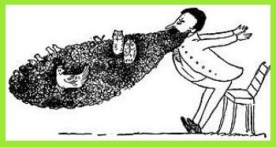
Nutty Fudge Day
Odometer Day
International Nurses’ Day
International Women in Mathematics Day *
_____________________________________
Eat What You Want Day
Foam Rolling Day *
Hostess CupCake Day *
Twilight Zone Day
_____________________________________

_________________________________
Welcome to The Coffee Shop, just for you early risers
on Monday mornings. This is an Open Thread forum,
so if you have an off-topic opinion burning a hole in
your brainpan, feel free to add a comment.
_________________________________
May Sarton (born Eleanore Marie Sarton), was an only child. Her parents fled with their two-year-old daughter from their Belgian homeland when the Germans invaded in 1914, first reaching Britain, and then on to America. Her father, who was a chemist, went to work at Harvard, and got a grant from the Carnegie Foundation. He became one of the notable 20th century historians of science. Her mother was English artist Mabel Eleanor Elwes.
Sarton is one of my most favorite poets. While her poem, August 3rd, was not written for Mother’s Day, it is a lovely tribute to a wonderful mother.
by May Sarton
These days
Lifting myself up
Like a heavy weight,
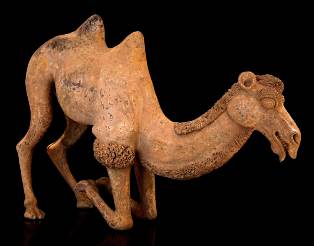
Old camel getting to her knees,
I think of my mother
And the inexhaustible flame
That kept her alive
Until she died.
She knew all about fatigue
And how one pushes it aside
For staking up the lilies
Early in the morning,
The way one pushes it aside
For a friend in need,
For a hungry cat.
Mother, be with me.
Today on your birthday
I am older than you were
When you died
Thirty-five years ago.
Thinking of you
The old camel gets to her knees,
Stands up,
Moves forward slowly
Into the new day.
If you taught me one thing
It was never to fail life.
For more May Sarton, click:
https://flowersforsocrates.com/2018/07/20/word-cloud-solitude/
___________________________
Every mother is a person first, and like all people, unique.
Click here for Diane Wakoski’s poem, “Thanking My Mother for Piano Lessons”

Clean Up Your Room Day
National Lipid Day *
National Shrimp Day
World Lupus Day *
_______________________________

Butterscotch Brownie Day
National Sleepover Day
World Moscato Wine Day
National Lost Sock Memorial Day
___________________________________
Coconut Cream Pie Day
World Ovarian Cancer Day *
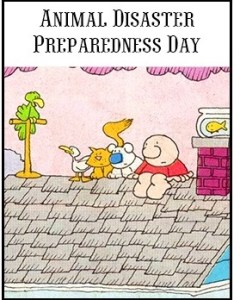
Animal Disaster Preparedness Day
World Red Cross and Red Crescent Day *
_____________________________________

by NONA BLYTH CLOUD
On April 27, 2020, Ireland lost one of its great poets.
Eavan Boland (1944-2020) was born in Dublin, Ireland, but her father was a career diplomat, so she spent part of her childhood in London, where she first came up against prejudice toward the Irish, and in New York City. At 14, she went home to Ireland for secondary school, and in 1966 earned a Bachelor of Arts with First Class Honors in English Literature and Language from Dublin’s Trinity College.
Boland was still a student when she published her first poetry collection, 23 Poems (1962). She married novelist and playwright Kevin Casey in 1969, and they had two daughters.
She will also be remembered as a teacher. Boland taught at Trinity College Dublin, University College Dublin, at Bowdoin College in Maine, and she was a member of the International Writing Program at the University of Iowa. She also spent time as a writer in residence at Trinity, and at Ireland’s National Maternity Hospital. She taught at the School of Irish Studies in Dublin, and was a Professor of English at Stanford University in California.
Eavan Boland died in Dublin at age 75, after suffering a stroke.
She said in an interview at A Smartish Pace: “I began to write in an Ireland where the word ‘woman’ and the word ‘poet’ seemed to be in some sort of magnetic opposition to each other. Ireland was a country with a compelling past, and the word ‘woman’ invoked all kinds of images of communality which were thought to be contrary to the life of anarchic individualism invoked by the word ‘poet.’ I found that a difficult and resistant atmosphere in which to write. I wanted to put the life I lived into the poem I wrote. And the life I lived was a woman’s life. And I couldn’t accept the possibility that the life of the woman would not, or could not, be named in the poetry of my own nation.”
When asked “Does the poet have a role in our society or is it a personal endeavor?” This was her answer:
“The true obligation of the poet is to make the poem well and truly. In doing that, she discharges every obligation an artist owes a society.”
___________________________
The linen map
hung from the wall.
The linen was shiny
and cracked in places.
The cracks were darkened by grime.
It was fastened to the classroom wall with
a wooden batten on
a triangle of knotted cotton.
We have no oracles,
no rocks or olive trees,
no sacred path to the temple
and no priestesses–
the teacher’s voice had a London accent.
This was London.
This was England. 1952.
It was Ancient History class.
Ireland was far away.
And farther away
every year.
I was nearly an English child.
I could list the English kings.
I could place the famous battles.
I was learning to recognize
God’s grace in history.
The colours
were faded out
so the red of Empire–
the stain of absolute possession–
the mark once made from Kashmir
to the oast-barns of the Kent
coast south of us was
underwater coral.
And the waters
of the Irish Sea,
their shallow weave
and cross-grained blue-green,
had drained away
to the pale gaze
of a doll’s china eyes:
a stare without recognition or memory.
She put the tip
of the wooden
pointer on the map.
She tapped over ridges and dried-
out rivers and cities buried in
the sea and sea-scapes which
had once been land.
And came to a stop.
The Roman Empire
was the greatest
Empire ever known.
(Until our time of course.)
Remember this, children.
In those days,
the Delphic Oracle was reckoned
to be the exact centre of the earth.
Suddenly
I wanted
to stand in front of it.
I wanted to trace over
and over the weave of
my own country and read out
names I was next to forgetting.
Wicklow. Kilruddery. Dublin.
To ask
where exactly
was my old house?
With its front door.
Its brass One and Seven.
Its flight of granite steps.
Its lilac tree whose scent
stayed under your fingernails for days?
For days,
she was saying, even months,
the ancients travelled to the Oracle.
They brought sheep and killed them.
They brought questions
about tillage and war.
They rarely left with more
than an ambiguous answer.
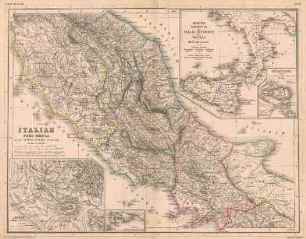
“In Which the Ancient History I Learn Is Not My Own” from In a Time of Violence: Poems, © 1994 by Eavan Boland – W.W. Norton & Company
___________________________
 Nicole Plyler Fisk
 Gene Howington
 FFS Guest Blogger
 Joy of Fishes
 Chuck Stanley
 shortfinals
 Terry Welshans
 ann li-summers
 wordcloud9


 Flowers For Socrates