You read that correctly: The President of the United States was tweeting approvingly an article describing his motivations as “invidious” and describing his actions using the phrase “incompetent malevolence.”
Orange Gazbag’s apparently so stupid that he’s apparently incapable of reading in context, and praises criticism of his White House’s incompetence and dysfunction on the ruling against the “Muslim ban”… based on a Morning Joe sound bite.
His Twitter spew will have not only a deleterious effect on legal proceedings but as his cultural illiteracy (as “President Donald”) with the Japanese PM shows, he’s as dim as his followers who trashed PBO for “bowing too low”, etc.
This is not how the White House is supposed to work. Whole apparatuses are supposed to be there to protect the President from sending out unvetted executive orders, tweeting attacks on federal judges that hurt the government’s chances of prevailing in court, and yes, even from tweeting articles he hasn’t read and that don’t say what he thinks they say….
Benjamin Wittes is editor in chief of Lawfare and a Senior Fellow in Governance Studies at the Brookings Institution. He is the author of several books and is co-chair of the Hoover Institution’s Working Group on National Security, Technology, and Law.
Trump’s tweets will haunt him for *all* national security actions going forward, interfering even with legitimate gov action pic.twitter.com/5gLKGJQl2l
I’ve read a lot of statements by writers about writing, and they are all true, but many of them are only true for that one writer and their particular ‘process.’
I like this comment by Nikki Giovanni (1943 – ), because I think it’s about the writers you keep coming back to, the ones who can still give you something at 50 that you never saw when you first read them at 18:
“I want to be clear about this. If you wrote from experience, you’d get maybe one book, maybe three poems. Writers write from empathy.”
It’s rare to find a young writer who writes from empathy. Most people, including writers, start out pretty self-obsessed, and English teachers have been reinforcing that for decades by telling their students to “write what you know.” It’s as good place as any to start, but most of us don’t know all that much in our teens and twenties, so many promising writers quickly run out of material, and go dry.
Nikki Giovanni was a kid in the 1950s, and “came of age” in the 1960s, which shifted from the uptight clothing and button-down minds of the 1950s to the idealism worn like a mantle by the Kennedys’ Best and Brightest, to voter registration and civil rights, the anti-war protests and the women’s movement. Ideas and emotions exploded.
In this poem, she looks back at the happy little girl she was, exploring the worlds in the books she eagerly takes from the library:
My First Memory (of Librarians)
This is my first memory: A big room with heavy wooden tables that sat on a creaky wood floor A line of green shades—bankers’ lights—down the center Heavy oak chairs that were too low or maybe I was simply too short For me to sit in and read So my first book was always big
In the foyer up four steps a semi-circle desk presided To the left side the card catalogue On the right newspapers draped over what looked like a quilt rack Magazines face out from the wall
The welcoming smile of my librarian The anticipation in my heart All those books—another world—just waiting At my fingertips.
I worked as an industrial adult educator for twenty years. My teaching credentials were granted by California in 1980. I have dealt with adult literacy on a regular basis teaching adults some pretty complex mechanisms and systems. I trained employees in the Federal regulations governing rail transportation operations (operating rules) and maintenance regulations. My signature was placed on Federal documents as proof the employee met the standard and knew how to do the tasks. I flunked a number of employees who could not read well enough to learn what was expected, or who could not read well enough to take the required tests. I can spot a non-reader in a minute, just by watching how they read and how they respond to simple comprehension questions.
Here are some tips to identify patients with reading problems and how to help them:
Look for signs. The first step is to identify patients who are functionally illiterate: unable to read and understand how to take medications or when to come in for a follow-up appointment. But experts say that identifying illiteracy is not always easy. You can’t depend on appearances; many well-dressed, even articulate patients have literacy problems. “You won’t see illiteracy unless you look for it,” said Dr. Parker.
Fortunately, though, there are some fast, easy ways to help confirm your suspicions that a patient may have literacy problems. Dr. Parker, for example, carries a pill bottle with her. “I take it out and ask patients to read it and tell me how they would take the medication,” she said.
Another technique is to tell your patients you want to test their vision and ask them to read a few sentences from a pamphlet. If they give you the age-old excuse that they left their reading glasses at home, be wary.
Here are a few videos proving the point that tRump does not read very well (or at all):
Uh-Oh: Does Donald Trump Know How to Read? by David Pakman
Note at 8:39, when asked to read a document, he says he needs his glasses.
WOW: Trump Fails Basic Literacy Test by David Pakman
Donald Trump and Literacy by Steve Kaufmann
This leads us to examining the limited (some say as few as 800 words) vocabulary he uses while speaking:
Kathryns’ Report, an aviation web site, reported today that Emirates says flight was delayed after Delta Airlines refused them a spare part. As Faux News says, “We report, you decide.”
DUBAI, Feb 9 Emirates has accused Delta Air Lines of harming its operations by refusing it a spare part for its aircraft in the United States, stoking tensions between U.S. and Gulf carriers feuding over state subsidies.
The Emirates flight from Seattle was delayed by more than six hours on Feb. 2, while it searched for the minor hydraulic part that needed replacing, an Emirates spokeswoman said.
Delta confirmed the incident, but said “this was the last spare part of its kind in our Seattle inventory and, according to policy, was kept on hand to ensure coverage for Delta’s own operation”.
“Having the right spare parts in the right places and in ample quantity is critical to ensuring a reliable airline operation for our customers,” Delta spokesman Michael Thomas said in emailed comments.
The hydraulic system part was initially fitted to the Emirates Boeing 777 by local engineers who had obtained the part from Delta, the Emirates spokeswoman said.
However, at the request of a “senior manager” at Delta’s headquarters in Atlanta the part was removed and returned just before passengers boarded resulting in a further delay, the spokeswoman said.
Delta is one of three U.S. carriers leading calls for the White House to limit the growth of major Gulf airlines.
“It is sad, in our view, that any airline would deny such standard, technical assistance to another carrier based on orders from headquarters that had nothing to do with maintenance or cost but seem clearly to have been intended to inflict harm on the airline and its customers,” the Emirates spokeswoman said.
An Emirates employee in Seattle offered a credit card to pay for the part, which it said was worth $300, but Delta refused, according to the spokeswoman.
Andy Pasztor reported February 9, 2017 in The Wall Street Journal: that in the wake of Mr. Trump’s executive order putting all new and pending regulations on hold for 60 days, the Federal Aviation Administration’s normally low-profile, routine safety directives temporarily were held up by the freeze. The FAA has resumed issuing routine rules calling for safety fixes to aircraft, following a 19-day pause prompted by President Donald Trump’s government-wide regulatory freeze.
The first mandatory safety orders, called airworthiness directives, were published in the Federal Register at the start of this week and five more appeared for public inspection Thursday on the publication’s website. In January, before Mr. Trump’s inauguration, some two dozen such rules were released by the FAA.
The White House order allowed for exemptions due to urgent concerns about health, safety or national security, though it took time for the Trump team to determine that FAA airworthiness directives fell into one of those categories, according to people familiar with the process.
The urgent safety recommendation is based upon preliminary findings in the ongoing investigation of the July 29, 2016, in-flight breakup of a Piper PA-31T medical transport flight in California. Investigators found evidence of thermal damage near the airplane’s main electrical bus circuit breaker panel.
These ADs include wiring problems on Piper PA-31T light twin airplanes where the under-panel wiring can chafe on fuel and hydraulic lines, resulting in inflight fires, something you do not want to experience. Yet, it took some time for trump’s team to determine that aviation safety may be impaired even though the above aircraft broke up in flight, killing all om board.
“…Trump, appears open to the clash-of-civilizations idea…” Steve Bannon, who has ascended in just months from relative obscurity to become one of President Trump’s most influential advisors, has said that Islam is “the most radical” religion in the world and the U.S. is engaged in a civilizational struggle potentially leading to “a major shooting war in the Middle East again.”http://www.usatoday.com/..
Huntington argues that states belonging to different civilizations will have a higher propensity to be involved in international conflict. This effect should be more prominent in the post-Cold War period. The civilization factor should also interact with membership in different Cold War blocs, border contiguity, regime type, and levels of modernization, magnifying or depressing the basic effects of these variables.
This study shows that state interactions across the civilizational divide are not more conflict prone.
The first eight years of the post-Cold War era also fail to give support to Huntington’s thesis. Moreover, while the civilization factor modifies the effects of border contiguity and regime type, this is not sufficient to generate conditions under which differences in civilizational heritage are associated with greater risks of conflict. www.hks.harvard.edu/…
Not if … when … will the preconditions for rationalizing war occur since leaked transcripts indicate that Lord Dampnut threatened Mexico with a military invasion to arrest drug criminals.
Or if he can ever recover from his pooch-screwing in Yemen in the first week due to desperate over-compensating for the embarrassment of his 2011 WHCD call-out while PBO was 11-dimensionally killing Osama bin Laden.
Happy Mayday Lofo Mofo.
Unnamed military officials told Reuters that “Trump approved his first covert counterterrorism operation without sufficient intelligence, ground support, or adequate backup preparations.”
“I have a little conflict of interest ’cause I have a major, major building in Istanbul…”
Michael Anton, who served as a speechwriter for President George W. Bush, joined President Donald Trump’s administration earlier this year as a staffer on the National Security Council. But in the year leading up to the 2016 election, Anton operated as an anonymous booster of then-candidate Trump. Using the pen name Publius Decius Mus (the name of a self-sacrificing Roman consul), Anton promoted Trump’s anti-Islam, anti-immigration platform on fringe websites. The Weekly Standard revealed Publius to be Anton last week.
As Publius, Anton is best-known for his September 2016 article, “The Flight 93 Election,” which argued that, like the passengers on the aircraft hijacked by al Qaeda on Sept. 11, 2001, Americans in 2016 needed to “charge the cockpit” and prevent Hillary Clinton from winning the election — or die. The article, which ran in the Claremont Review of Books, was circulated widely on conservative and white nationalist websites. The New Yorker declared it “the most cogent argument for electing Trump” but cited the responses by Ross Douthat of The New York Times that he’d “rather risk defeat at my enemies’ hands than turn my own cause over to a incompetent tyrant” and by Jonah Goldberg of National Review that its central metaphor is “grotesquely irresponsible.”



 You read that correctly: The President of the United States was tweeting approvingly an article describing his motivations as “invidious” and describing his actions using the phrase “incompetent malevolence.”





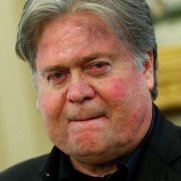 Steve Bannon, who has ascended in just months from relative obscurity to become one of President Trump’s most influential advisors, has said that Islam is “the most radical” religion in the world and the U.S. is engaged in a civilizational struggle potentially leading to “a major shooting war in the Middle East again.” http://www.usatoday.com/..




 Nicole Plyler Fisk
 Gene Howington
 FFS Guest Blogger
 Joy of Fishes
 Chuck Stanley
 shortfinals
 Terry Welshans
 ann li-summers
 wordcloud9


 Flowers For Socrates