
Good Morning!

____________________________
____________________________

____________________________
Welcome to The Coffee Shop, just for you early risers
on Monday mornings. This is an Open Thread forum,
so if you have an off-topic opinion burning a hole in
your brainpan, feel free to add a comment.
____________________________

____________________________
Welcome to The Coffee Shop, just for you early risers
on Monday mornings. This is an Open Thread forum,
so if you have an off-topic opinion burning a hole in
your brainpan, feel free to add a comment.
____________________________
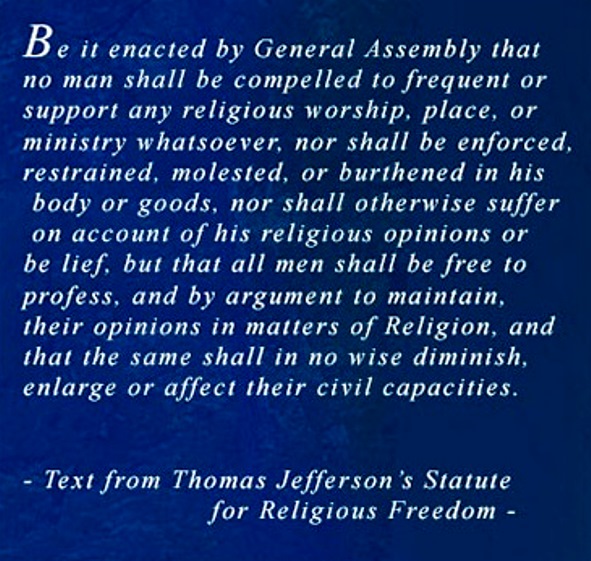
Sunday, January 16, 2022, will be Religious Freedom Day, a celebration of this statute, written by Thomas Jefferson, and passed by the Virginia Assembly on January 16, 1786, which became the basis for the protections of religious freedom in the First Amendment to the U.S. Constitution.
_______________________
PLEASE NOTE: I have quoted extensively from The Woman’s Bible. It is out of copyright, the contributors are dead, and the entire book is available online: https://www.gutenberg.org/cache/epub/9880/pg9880.html – under these terms:
This eBook is for the use of anyone anywhere at no cost and with almost no restrictions whatsoever. You may copy it, give it away or re-use it under the terms of the Project Gutenberg License included with this eBook or online at www.gutenberg.org
It was produced by Carrie Lorenz and John B. Hare
_______________________
There have always been individual women, and even a few men, who spoke out against the subjugation of women, but they were single voices, or a chorus of the few drowned out by the silence of the many women, and the roar of Patriarchy.
But in the 19th century, the chorus of the few began to grow, and in July, 1848, in Seneca Falls, New York – which was already a hotbed of abolitionist activity – Jane Hunt, Lucretia Mott, Elizabeth Cady Stanton, Martha Wright, and Mary Ann McClintock organized a woman’s rights convention. The Seneca Falls Convention became the launch pad for the women’s movement in America.

____________________________
January 5, 1949 – United States President Harry S. Truman unveils his Fair Deal program, which included: Major improvements in unemployment compensation; Raising the minimum wage to 75¢ an hour, and extending who was covered; Increasing and extending Social Security benefits, and creating a Universal Healthcare system; Measures to ease the U.S. out of a wartime economy into peacetime; Transitional jobs for demobilized military personnel, and increased aid for war veterans returning to civilian life; Increased aid to farmers and small businesses; Enactment of comprehensive housing legislation; Overhauling the federal tax code; Expansion of public works; Revising the pay scale upward for federal employees.

____________________________
W. S. Merwin (1927–2019) was an American poet who wrote more than fifty books of poetry and prose, and produced many translations. In the 1980s and 1990s, his writing influence derived from an interest in Buddhist philosophy and deep ecology. Residing in a rural part of Maui, Hawaii, he wrote prolifically and was dedicated to the restoration of the island’s rainforests. He won the Pulitzer Prize for Poetry twice, in 1971 and 2009, and the National Book Award for Poetry in 2005. He was named as the U.S. Poet Laureate (2010-2011).
To read W.S. Merwin’s poem, To the New Year, click:
 Nicole Plyler Fisk
 Gene Howington
 FFS Guest Blogger
 Joy of Fishes
 Chuck Stanley
 shortfinals
 Terry Welshans
 ann li-summers
 wordcloud9


 Flowers For Socrates