
by NONA BLYTH CLOUD
I wrote this poem after opening my copy of For the Sleepwalkers to begin work on an earlier, shorter version of this profile, which I originally published at another website. There was still a faint smokiness in the pages of the book from the long-ago fire which burned our former home, carrying with it so many memories – we were able to save almost all of our books, and no one was seriously injured, but it was our first home together.
A Penny Patron of The Arts
– for Edward Hirsch
by Nona Blyth-Cloud
A first edition book of poems newly printed in 1981
its back-cover worth: $5.95
By the time my hand brushed over it on the bookstore
bargain table, stickers had drifted down
past $1.99 and settled at 99¢
I thumbed through your pages looking
for 4 poems I liked enough
to pay 25¢ apiece
Please don’t be insulted – 99¢ was a much bigger slice
of my paycheck then for a lean-thewed paperback
of higher than four-poem value
I still have your book
splintering glue cracked its spine,
but the dense pages are only a little yellowed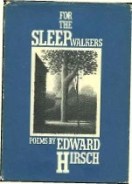
We’ve traveled long together, these poems and I,
survivors through fire and earthquake,
that ever-sameness of eternal change
A thing of tape and patches
but still your “thumbprint of another life”
_____________________________________
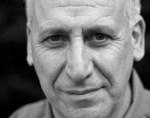
Edward Hirsch (1950 – ) poet, critic, and “Poet’s Choice” columnist for the Washington Post, said in an interview for Contemporary Authors: “I would like to speak in my poems with what the Romantic poets called ‘the true voice of feeling.’ I believe, as Ezra Pound once said, that when it comes to poetry, ‘only emotion endures.’”
The word “quotidian” comes up a lot in discussions of Hirsch’s poetry – a scholarly word for everyday or mundane. While that might describe the subjects in many of his poems, it is not a word that suits the poems.
A Partial History Of My Stupidity
Traffic was heavy coming off the bridge,
and I took the road to the right, the wrong one,
and got stuck in the car for hours.
Most nights I rushed out into the evening
without paying attention to the trees,
whose names I didn’t know,
or the birds, which flew heedlessly on.
I couldn’t relinquish my desires
or accept them, and so I strolled along
like a tiger that wanted to spring
but was still afraid of the wildness within.
The iron bars seemed invisible to others,
but I carried a cage around inside me.
I cared too much what other people thought
and made remarks I shouldn’t have made.
I was silent when I should have spoken.
Forgive me, philosophers,
I read the Stoics but never understood them.
I felt that I was living the wrong life,
spiritually speaking,
while halfway around the world
thousands of people were being slaughtered,
some of them by my countrymen.
 So I walked on — distracted, lost in thought —
and forgot to attend to those who suffered
far away, nearby.
Forgive me, faith, for never having any.
I did not believe in God,
who eluded me.
_____________________________________
Continue reading →







 Nicole Plyler Fisk
 Gene Howington
 FFS Guest Blogger
 Joy of Fishes
 Chuck Stanley
 shortfinals
 Terry Welshans
 ann li-summers
 wordcloud9


 Flowers For Socrates