Since Maryland first chose the Chesapeake Bay Retriever as its State Dog in 1964, the idea of having a state dog has been growing in popularity.
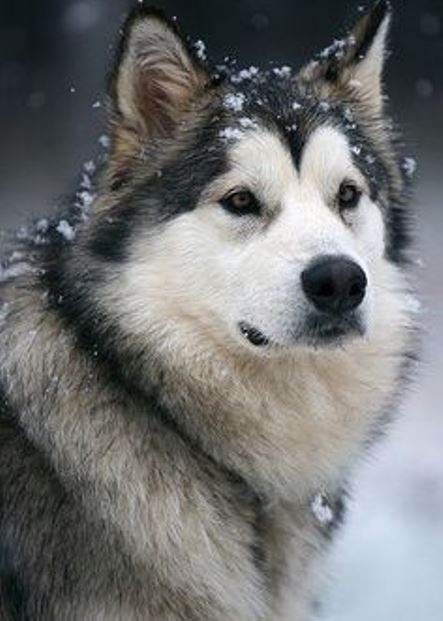
In 2010, Alaska became one of 12 states which have designated an official state dog. Their choice is the impressive Alaskan Malamute.
Alaskan Malmutes are members of the Spitz group of dogs, traced back 2,000 to 3,000 years ago to the Mahlemuits tribe. The Malamute is a large working breed, originally developed for hauling heavy freight in multiple-dog teams, and later sometimes used as a sled dog over very long distances. Renowned for their strength and endurance, they usually range in weight between 75 and 95 pounds.
They have an oily wooly undercoat, which can be up to two inches thick, and an outer guard coat that is coarse and stands off the body, usually in shades of gray, sable, seal or red, with white. Malamutes frequently have a white facial ‘mask.’
They are infrequent barkers, but they do make a “woo woo” sound and sometimes howl like wolves.
There is much to admire about Canada. Its natural beauty, its wonderful people, and its somewhat amused tolerance of its big loud neighbor to the south.
And now, there’s one more thing to like:
Thank you, Molson Canadian. May this spirit of sharing common goals and communal cooperation spread far beyond your borders.
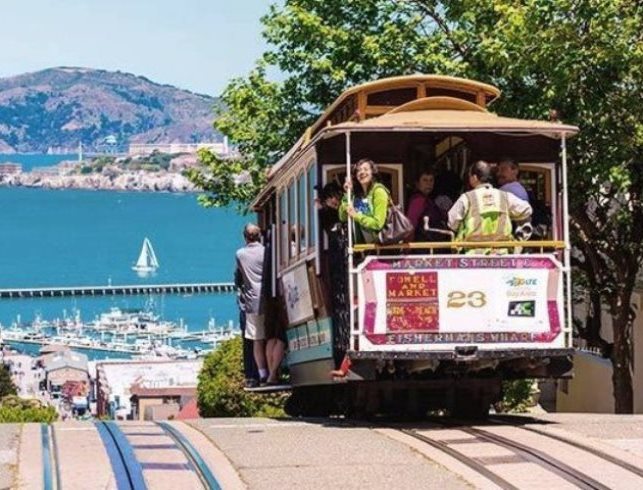
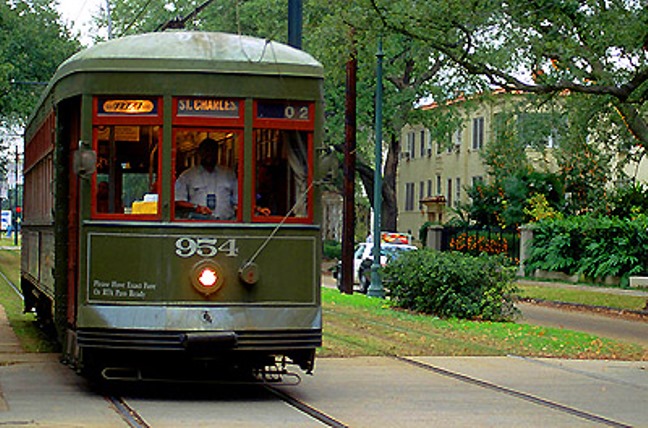
Most National Landmarks and Monuments stand still, but these two are National Landmarks because they move — people from place to place.
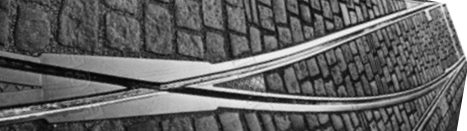
The world’s first cable car line, on Clay Street in San Francisco, began service in August 1873. Cable cars were invented by Andrew S. Hallidie, a Scots-born mining engineer. Legend says he saw horses struggling and slipping trying to pull a railcar filled with passengers up one of San Francisco’s hills and decided to adapt his mining conveyor technology to pull rail cars, by means of an endless loop of cable under the street, between the tracks.
In 1964, San Francisco’s cable cars were named the first moving National Historic Landmark. Today, both their continued operation and minimum level of service are locked into San Francisco’s City Charter.
On September 30, 2014, New Orleans’ St. Charles streetcar line was granted national historic landmark status by the Department of the Interior, becoming the second U.S. mobile landmark. The St. Charles line was singled out as the oldest continuously operating streetcar system in America, having operated on the lines tracks since 1923.
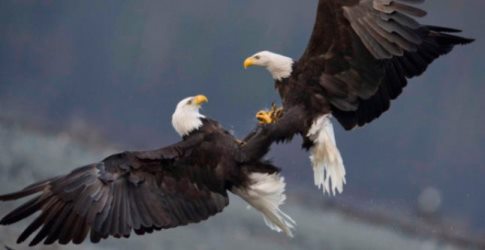
We almost lost the Bald Eagle (Haliaeetus leucocephalus), our national bird, symbol of our country, in the 1950s, because of the widespread use of the pesticide DDT. Then in 1962, Rachel Carson’s book, Silent Spring, made people aware of what was happening, not just to the eagles, but to many other birds and wildlife.
Ten years later, DDT was banned in the U. S. and the bald eagle was put on the newly created Endangered Species List. By that time, the eagles had disappeared from the Channel Islands off the coast of California.
This is the story of their return.
Habitat conservation and reintroduction efforts like the program at the Channel Islands have helped the recovery of the bald eagles. They were removed from the Endangered Species List in 2007.
The Dalliance of Eagles
by Walt Whitman
Skirting the river road, (my forenoon walk, my rest,) Skyward in air a sudden muffled sound, the dalliance of the eagles, The rushing amorous contact high in space together, The clinching interlocking claws, a living, fierce, gyrating wheel, Four beating wings, two beaks, a swirling mass tight grappling, In tumbling turning clustering loops, straight downward falling, Till o’er the river pois’d, the twain yet one, a moment’s lull, A motionless still balance in the air, then parting, talons loosing, Upward again on slow-firm pinions slanting, their separate diverse flight, She hers, he his, pursuing.
The Eagle
by Alfred, Lord Tennyson
He clasps the crag with crooked hands; Close to the sun in lonely lands, Ring’d with the azure world, he stands.
The wrinkled sea beneath him crawls; He watches from his mountain walls, And like a thunderbolt he falls.
The American Bald Eagle is a sea eagle, related to the White-Tailed Eagle (Haliaeetus albicilla) that inhabits the coastal areas of the United Kingdom, especially the rugged shoreline of Scotland. In Scots Gaelic, the White Tail is called eye Iolaire sùil na grèine, ‘the eagle with the sunlit eye.’
It also seems a fitting description of their American cousins in the Channel Islands.
1054 – Chinese and Arab observers record supernova – remnants form Crab Nebula
1776 – Continental Congress adopts Declaration of Independence
1817 – Erie Canal Construction begins, to connect Lake Erie with the Hudson River
1826 – Thomas Jefferson and John Adams die on the same day
1827 – Slavery is abolished in New York state
1855 – Walt Whitman’s Leaves of Grass is published
1903 – Dorothy Levitt becomes first English woman to compete in a ‘motor race’
1966 – LBJ signs Freedom of Information Act into law
1969 – The Rolling Stones U.K. release of “Honky Talk Women”
I met a gin soaked, bar-room queen in Memphis, She tried to take me upstairs for a ride. She had to heave me right across her shoulder ‘Cause I just can’t seem to drink you off my mind.
It’s the honky tonk women Gimme, gimme, gimme the honky tonk blues.
I laid a divorcee in New York City, I had to put up some kind of a fight. The lady then she covered me with roses, She blew my nose and then she blew my mind.
It’s the honky tonk women Gimme, gimme, gimme the honky tonk blues.
It’s the honky tonk women. Gimme, gimme, gimme the honky tonk blues.
It’s the honky tonk women. Gimme, gimme, gimme the honky tonk blues
1997 – The Mars Pathfinder deploys Sojourner on Mars
The Coffee Shop is an open thread-style discussion forum for human interest news of the day.
—oooOooo–
There are several hosts, each host being responsible for picking a “theme of the day” and starting the discussion. But in an open thread, there’s no hard and fast rule about staying on topic, especially if you have a personal story burning a hole in your pocket trying to escape.
Pictures and videos are welcome in the comments. If photos are used, please be sure you own the copyright. We would rather see your personal photos anyway, instead of random stuff copied from the internet. Our only request is that if you use pictures or videos, take pity on those who don’t have broadband, and don’t post more than two or three in a single comment.
This is an Open Thread. Grab your cup, pull up a chair, sit a spell and share what’s on your mind today.
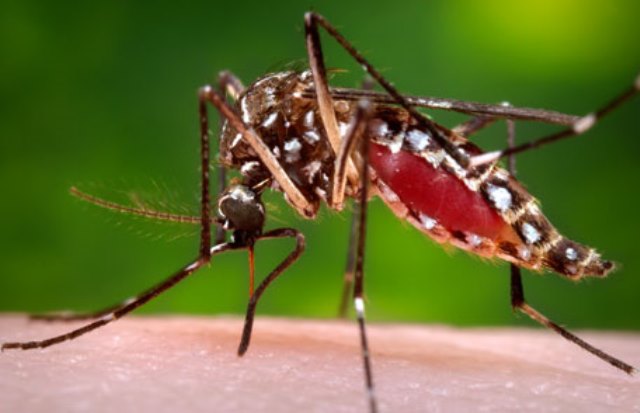
In lieu of launching yet another paean on the annual swelling flood of patriotism, I’ve decided instead to address that relentless summer menace, the mosquito.
In the news recently – a study that discovered who is most likely to be bitten by mosquitoes. Turns out, I’m one of the billions of humans doomed by Blood Type O, which apparently sings a siren song to them.
Sweaty athletes, pregnant women and those who imbibe alcoholic beverages are also irresistible. This is most concerning of course for pregnant women, in light of the increasing threat of the Zika virus.
But we have been battling these tinny shrieking scourges since our earliest days on earth, and this war seems unwinnable by either side.
So if you are going to grill out on the deck, drink a cold one on the veranda, or engage in any activity that makes you break a sweat — I earnestly urge you to first anoint yourself with insect repellent, then strap on some 21st century armor — a long-sleeved shirt made of moisture-wicking fiber.
Happy 4th, and may good fortune attend you as you go into battle.
The Mosquito
by John Updike
On the fine wire of her whine she walked Unseen in the ominous bedroom dark A traitor to her camouflage, she talked A thirsty blue streak distinct as a spark, I was to her a fragrant lake of blood From which she had to sip a drop or die A reservoir, a lavish field of food I lay awake, unconsious of my size We seem fair-matched opponents, soft she dropped Down like a anchor on her thread of song Her nose sank thankfully in; then i slapped At the sting on my arm, cunning and strong A cunning, strong gargantua. i struck This lover pinned in the feast of my flesh Lulled by my blood, relaxed, half-sated, stuck Engrossed in the gross rivers of myself Success, without a cry the creature died Became a fleck of fluff upon the sheet The small welt of remorse subsides as side By side we, murderer and murdered, sleep.
“I have never been called to attend a case of Gila monster bite, and I don’t want to be. I think a man who is fool enough to get bitten by a Gila monster ought to die. The creature is so sluggish and slow of movement that the victim of its bite is compelled to help largely in order to get bitten.”
— Dr. Ward, Arizona Graphic, September 23, 1899
The Gila monster (Heloderma suspectum, ‘studded skin, suspected’ – of being poisonous) is the only venomous lizard native to the United States. It lives in Arizona, the southern desert regions of California, Nevada, Utah and New Mexico.
The word ‘Gila’ comes from the Gila River and the Gila River Basin. In the language of the Yuman people, Gila means ‘salty’ and is pronounced ‘hee-la.’
This “monster” has been the victim of many exaggerated myths and misconceptions. The Apaches believed its breath could kill a man, and the Tohono O’Odham and the Pima believed it possessed a spiritual power that could cause sickness. But the Seri and the Yaqui believed the Gila monster’s hide had healing properties. Early white settlers believed that its ‘fetid’ breath was toxic, and being bitten by one would kill an adult human.
Gila monster venom is very toxic, but its delivery system is designed to immobilize very small prey, so too little venom is produced to kill a healthy adult human, and their sluggish nature makes them not much of a threat to people. After Scientific American printed an article that repeated the “evidence” of the Gila Monster’s “toxic” breath in 1890, Dr. George Goodfellow of Tombstone, Arizona, decided to study actual Gila monster specimens. He paid local residents $5.00 for each Gila monster they could capture and bring to him. In 1891, Goodfellow deliberately provoked one of his captive lizards to bite him on his finger. The bite made him ill and he spent the next five days in bed, but he completely recovered.
When Scientific American ran another ill-founded report on the lizard’s ability to kill people, Dr. Goodfellow wrote in reply and described his own studies and personal experience. His articles about his research were later published by Scientific American and Southern California Practitioner.
Recently, medical science has analyzed the constituents of the Gila monster’s venom and saliva, and used them to develop synthetic versions of a protein, exendin-4, now used in a drug (marketed as Byetta) for the management of type 2 diabetes. They have also derived ‘Gilatide’ from exendin-4, which has shown promise in reversing memory loss in mice. Several companies are now researching its possible use in the treatment of Alzheimer’s, schizophrenia and ADHD.
tehDumpster fire that is the Trump campaign is now trolling the LIVs in swing states with the usual xenophobia and GOP talking points. Trump’s disinformation campaign could even favor TPP because HRC is against it.
Recall how effective rMoney’s meme of Chinese currency manipulation worked in 2012. Even the RW and capitalist media is weighing in against Trump as Forbes, USNews, and NatReview wrote this week…
Donald Trump is rather doubling down on his rhetoric about China and trade.This might well be a good political tactic as there’s an incredible number of people who simply do not understand the subject. This is also extraordinarily bad economics and public policy but then political campaigns can be like that.
There’s also a certain uncertainty about whether he has quite understood the Brexit result – that wasn’t about people not wanting cheap imports of goods and services, rather not wanting imports of people. And if the people aren’t going to come then as Bastiat didn’t quite point out then the goods should…
Donald Trump continued blasting the Trans-Pacific Partnership (TPP) on Tuesday, likening it in an afternoon speech to “rape.”
“It’s a rape of our country. It’s a harsh word, but that’s what it is—rape of our country,” Trump said at an evening rally in St Clairsville, Ohio.
Sure, we’ve all got to make certain allowances for political rhetoric but no, allowing people to sell us cheap goods really is nothing at all like the vile crime of rape. The most important part of the definition of rape being without consent. And if Americans are voluntarily lining up to purchase lovely cheap things made in other parts of the world we can hardly claim that there is that absence of consent, can we?
Criticising the current US trade policies that has wiped out American manufacturing, presumptive Republican presidential nominee Donald Trump has threatened to take punitive actions against China’s illegal trade activities while promising to herald a US economic resurgence if elected.
“If China does not stop its illegal activities, including its theft of American trade secrets, I will use every lawful presidential power to remedy trade disputes, including the application of tariffs…,” Trump said in his remarks on economy in the Monessen township of Pennsylvania…
There is also the rather larger underlying problem here, Trump is simply wrong about the very basics of trade. Imports are what make us richer so complaining about our being made richer by lots of cheap imports is simply ridiculous. But then large parts of the population (and this is true everywhere, it’s not just an American thing) don’t get this and so what is a politician on the stump supposed to do? Tell the electorate they’re all wrong or try to gain their votes by agreeing with them?
it may be that tRump is an even stupider “business” POTUS candidate than GWB.
I’m going to instruct my Treasury Secretary to label China a currency manipulator, which should have been done years ago,” Trump said. “Any country that devalues their currency in order to take unfair advantage of the United States, and that includes many countries, will be met with sharply. And that includes tariffs and taxes.”
But Chinese Foreign Ministry Spokesman Hong Lei fired back later in the week – an uncharacteristic move for Beijing given the country’s general avoidance of the U.S. presidential election cycle up to this point.
“It is hoped that relevant people in the U.S. can objectively and rationally view China-U.S. trade relations, do more to enhance mutual trust and cooperation and jointly maintain the sound and steady development of bilateral economic and trade ties.”
Even the RWNJs at National Review (after their disavowal of tehDonald) are not convinced by the retreat to old GOP memes
In reality, anxiety about Beijing’s artificial currency devaluation has subsided over the past year because Beijing has been pushing as hard as it can in the opposite direction, having spent half a trillion dollars since last August trying to prop up the renminbi rather than trying to drive it down. China has to buy imports, too, and like any other modern industrial economy, it relies on foreign-sourced materials and inputs for critical parts of its production, including exports. China, and the world, would be better off in the long term with a floating renminbi, but the markets have in fact done a reasonably good job disciplining Beijing in this matter.
NAFTA, the trade agreement Trump promises to gut, has in fact had a modest positive effect on U.S. employment and wages. Chinese currency policy — and Chinese trade policy at large — is a minor factor when it comes to what Trump says is his main interest, which is employment and wages in the United States. Study after study has shown that automation is a larger and more significant factor in factory employment than is the price of tea in China. That is why promises to bring back lost factory jobs are doomed to fail: Factory jobs have in the main been lost not because of foreign competition but because our factories have become more efficient and need fewer workers. The same thing happened with agriculture an age ago, and it will happen with other industries in the future.











 Nicole Plyler Fisk
 Gene Howington
 FFS Guest Blogger
 Joy of Fishes
 Chuck Stanley
 shortfinals
 Terry Welshans
 ann li-summers
 wordcloud9


 Flowers For Socrates