
by Nona Blyth Cloud
Alice Walker (1944 – ) is famous for her novels, especially her third novel, The Color Purple.
Since it was first published in 1982, The Color Purple earned the National Book Award for Fiction and the Pulitzer Prize for Fiction, the first time it was awarded to an African-American woman. Five million copies, in 25 languages, have been sold. It was made into a film in 1985 that was nominated for 11 Academy Awards, grossed over $98,000,000, and launched Oprah Winfrey into stardom.
But she published Revolutionary Petunias, a book of poetry, almost ten years before The Color Purple turned Alice Walker into a literary phenomenon.
The first poem of Petunia’s opening section, In These Dissenting Times, was untitled:
I shall write of the old men I knew
And the young men
I loved
And of the gold toothed women
Mighty of arm
Who dragged us all
To church.
Alice Walker was born in Eatonton, Georgia, about 78 miles from Atlanta. It was also home to Joel Chandler Harris, who wrote the Uncle Remus fables in the late 19th century.
Eatonton is a dairy farming community, which had fewer than 2500 residents in the 1940s and 50s of Alice Walker’s childhood. There are two lakes, a small national forest and a Native American archaeological site nearby. Her parents, Willie Lee and Minnie Lou Grant Walker, were sharecroppers. Alice was the youngest of their eight children.
She has said of her father, that he was “wonderful at math but a terrible farmer.” He earned only $300 a year from sharecropping and dairy farming. Her mother worked as a maid, 11 hours a day for $17 a week.
The “Jim Crow” laws, which enforced the South’s racial segregation, made it hard for a child of black sharecroppers to get an education. Minnie Lou Walker was once told by a white plantation owner that black people had “no need for education.” Alice remembers her mother saying, “You might have some black children somewhere, but they don’t live in this house. Don’t you ever come around here again talking about how my children don’t need to learn how to read and write.” Minnie Lou Walker enrolled her daughter in first grade when Alice was only four years old.
When she was 8 years old, Alice was shot in the right eye with a BB pellet while playing cowboys and Indians with two of her brothers. Whitish scar tissue in her damaged eye made her self-conscious and withdrawn. “For a long time, I thought I was very ugly and disfigured,” she told John O’Brien in Alice Walker: Critical Perspectives, Past and Present. She found solace in reading and writing poetry.
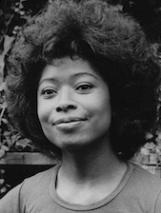 The injury to her eye made her eligible for a partial college scholarship. Her mother’s work as a maid helped pay the rest of the costs for her education.
Alice Walker went to Spelman College. Like many others, she was inspired by Martin Luther King, and became part of the Civil Rights movement, participating in voter registration, sit-ins and other protests. In 1962 she was invited to the home of Dr. King, in recognition of her attendance at the Youth World Peace Festival in Finland.
She completed her B.A. at Sarah Lawrence College in New York. While at Sarah Lawrence, Walker visited Africa as part of a study-abroad program. She graduated in 1965 — the same year she sold her first short story. She published her first book, Once: Poems, in 1968, containing poems about the civil rights movement, her personal anguish about deciding to get an abortion, and her travels to Africa.
The rhythms of her poems, especially the early ones, echo the cadence of her Georgia upbringing.
The Old Men Used to Sing
The old men used to sing
And lifted a brother
Carefully
Out the door
I used to think they
Were born
Knowing how to
Gently swing
A casket
They shuffled softly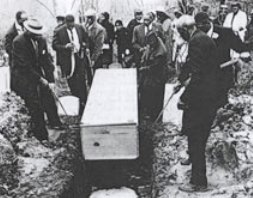
Eyes dry
More awkward
With the flowers
Than with the widow
After they’d put the
Body in
And stood around waiting
In their
Brown suits.
Continue reading →









 Nicole Plyler Fisk
 Gene Howington
 FFS Guest Blogger
 Joy of Fishes
 Chuck Stanley
 shortfinals
 Terry Welshans
 ann li-summers
 wordcloud9


 Flowers For Socrates