
December 2nd is
National Fritters Day
National Mutt Day II *
Safety Razor Day *
Special Education Day *
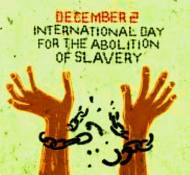
International Day for the Abolition of Slavery *
_____________________________________________
National Fritters Day
National Mutt Day II *
Safety Razor Day *
Special Education Day *
International Day for the Abolition of Slavery *
_____________________________________________

Antarctica Day *
Civil Air Patrol Day *
Day With(out) Art *
Eat a Red Apple Day
National Fried Pie Day
World AIDS Awareness Day *
_______________________________________________________

by NONA BLYTH CLOUD
The first day of December – three weeks before the Winter Solstice in the Northern Hemisphere, or the Summer Solstice in the Southern Hemisphere.
In many northern places, winter has already arrived: the summer birds left some time ago for the warmth of southern climes, the trees are bare, and the first snow has fallen. But whether the view from your window is icicles or kids on bicycles, we have all left spring or autumn behind, and the natural rhythm of Life slows down – it’s only humans who keep on racing, trying to catch the Future. The planet’s other land and sky dwellers are settling down for a winter’s nap, or a long, lazy day in the sun.
_____________________________________________________
This week’s poets each have something particular to say about this time of year. First up is William Carlos Williams (1883-1963), an American physician, novelist and poet, who managed to combine life as a small town doctor with being part of the modern imagist revolution in American prose and poetry. Though born in the U.S., his father was English and his mother was Puerto Rican, giving him a rich and diverse cultural heritage to draw upon. Many of his contemporaries became expatriates in Europe, developing new ways of writing out of their disaffection with America, yet still being out-of-place abroad. The work of William Carlos Williams fits with the expats, but also stands apart.
All the complicated details
of the attiring and
the disattiring are completed!
A liquid moon
moves gently among
the long branches.
Thus having prepared their buds
against a sure winter
the wise trees
stand sleeping in the cold.
Snow:
years of anger following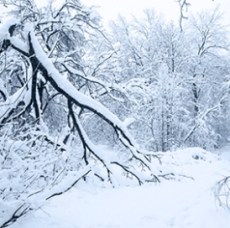
hours that float idly down —
the blizzard
drifts its weight
deeper and deeper for three days
or sixty years, eh? Then
the sun! a clutter of
yellow and blue flakes —
Hairy looking trees stand out
in long alleys
over a wild solitude.
The man turns and there —
his solitary track stretched out
upon the world.
“Winter Trees” and “Blizzard” from Sour Grapes: A Book of Poems (1921) by William Carlos Williams, reprinted in 2017
https://www.poetryfoundation.org/poets/william-carlos-williams
_____________________________________________________

Cities for Life Day *
Computer Security Day *
Mason Jar Day *
Mousse Day

National Meth Awareness Day *
___________________________________________________________

Electronic Greeting Card Day
National Lemon Cream Pie Day
National Square Dance Day
International Day of Solidarity
with the Palestinian People *
__________________________________________________________
My sister was diagnosed with lung cancer about six months ago. She went to her doctor with a concern about her shortness of breath and a chronic cough. The doctor had her admitted to the local hospital for diagnosis, which I am certain was only a formality as her symptoms clearly pointed to an advanced lung cancer.
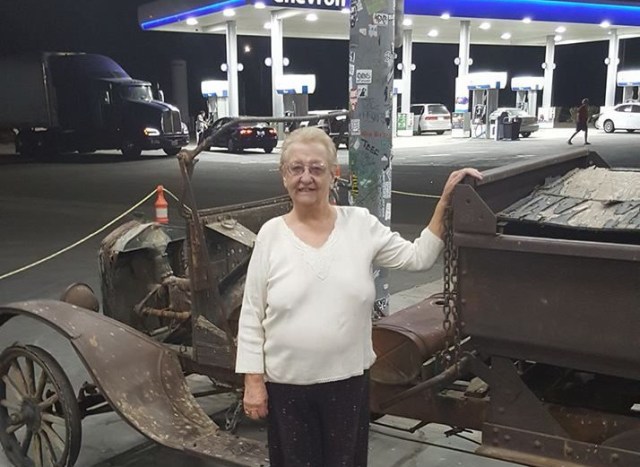
Janice Lynne Macleay 11/9/1949 – 11/28/2017

French Toast Day
Red Planet Day *
World Day of Giving *
Giving Tuesday
_________________________________________________________
Bavarian Cream Pie Day

International CARE Day *
Pins and Needles Day *
National Statistics Day *
Cider Monday *
Cyber Monday *
_____________________________________________

_________________________________________________________
 Continue reading

WHAT AN INTERNET WITHOUT NET NEUTRALITY WILL LOOK LIKE
FCC chair, Ajit “Pay Toilet” Pai, attempted recently to refute claims that “repealing utility-style regulation will destroy the Internet as we know it and harm innovation” by saying Net Neutrality would be ensured by corporate transparency (see “trust us, we’re making money from you and we’re not even bankers”).
In most of its configurations it still uses all or part of the same transit corridors as other utilities. Despite the invisibility of wireless, the transmission system still has the structure of wireline networks and invariably has that structure (see coverage maps which mimic the roadway network).

do congestion prices innovate or is it more about cost-shifting
Eliminating utility-style(sic) regulation will introduce de facto congestion pricing and resegregates bandwidth in favor of corporate greed that will have a disproportionate effect on the digital divide(s).
Such pricing sounds OK when one thinks about reducing negative externalities like air quality and fossil-fuel consumption, but at some moment it won’t actually finance EV development, or regulatory removal of polluting equipment. Similarly, carbon crediting is also about commodifying pollution, as if its trade would stop children getting asthma.
Because it is about acceptable and new centers for profits, and like the climate deniers, telecom industries only appear to have no negative information externalities because digital knowledge seems more fungible.
The resemblance resides in the current White House Twitler, proving how false consciousness and stupidity converge.

Some amendments to the Rural Electrification Act include:
1944 – loan terms increased to 35 years, the act is made permanent[3]
1949 – extended the act to allow loans to telephone companies wishing to extend their connections to unconnected rural areas[4]
1993 – Provisions to restructure the direct loan programs for rural electricity, telephone cooperatives, and energy conservation market[5]
December 8, 1993 – “North American Free Trade Agreement Implementation Act” – The “Buy American” provision to now include Mexico and Canada.
2008 – Provisions for access to rural broadband telecommunications network and rural internet
2014 – Pilot program for rural gigabit broadband network

Making money at the margins by privatizing property and services: Pay Toilets and Toll Roads
Reregulation to address the problem of cross-subsidies which address inequality has always been important for utilities, whether it’s home energy or telephone service to rural areas. The FCC rarely micromanages except in cases appropriate to its original mandate to reduce interference and congestion in the public interest.
The real capital surface is of course sprawled, and the space between city and country in suburban development is the actual territory where broadband profits reside.
Even as a complex geolocational construction, the electromagnetic spectrum is still a commons, however tragic.
Pai assumes that investment decline even as network infrastructure has surplus capacity suggests that it’s just about resegmenting the market to enable more speculative investment. It is about finance capital and all the capitalist lies meant to ensure profitability at the cost of alienating consumers.
More troubling is that Pai’s deregulatory claims are short-sighted at best, like most policy proposals under neoliberal capitalism, and at worst simply another speculative capital grab no different than the auctioning of spectrum in 1996.
Pai’s clumsy Republicanism fosters media oligopolies at national/regional/local levels and inhibits innovation insofar as access becomes skewed to consumption and limits small-producer broadband support. It’s not the absolute doom of the Internet, it’s just putting up more fences and getting more corporate, gated communities -— a manorial division of spectrum, where someone might shoot you if you trespass.
Like the South Sea Bubble and Trickle-Down Economics, it’s another capitalist confidence game, making the public private, because they can, and have more lawyers.
The real problem or advantage is that owning multiple digital delivery devices will have multiple profit channels for complex access (see price gouging when you’re on vacation or if you wander into an expensive neighborhood and you want to watch something streamed). The simpler example of this is why things are so expensive in convenience stores or food more pricey in airports.

1. Title II is a depression-era rule intended for regulating the AT&T/Ma Bell monopolyTL;DR: A law from another time, yes, but a strong one that’s been updated
The age and regulatory environment of the statute under which the current net neutrality rules are enforced is a common refrain. Title II is in fact part of the far-reaching Communications Act of 1934, which was indeed instated during a period of depression and monopoly — but characterizing it that way is a bit like saying the Declaration of Independence is an “Enlightenment-era rule written by anti-government extremists.”
 Nicole Plyler Fisk
 Gene Howington
 FFS Guest Blogger
 Joy of Fishes
 Chuck Stanley
 shortfinals
 Terry Welshans
 ann li-summers
 wordcloud9


 Flowers For Socrates