Morning Open Thread is an open discussion forum for human interest news of the day, hobby and fun things, what you did on your vacation, and your local weather phenomena.
In this dramatization of transcripts from a legal deposition, lawyers grapple with a plaintiff’s bizarre testimony about the destruction of his chicken’s pasture.
This is a daily open thread. There are several hosts, each host being responsible for picking a “theme of the day” and starting the discussion. However, there is no hard and fast rule about staying on topic, especially if you have a personal story burning a hole in your pocket trying to escape.
Pictures and videos are welcome in the comments. If photos are used, please be sure you own the copyright. We would rather see your personal photos anyway, rather than random stuff copied from the internet. Our only request is that if you use pictures or videos, take pity on those who don’t have broadband, and don’t post more than two or three in a single comment.
Morning Open Thread will be set to post at (or about) 6:30 AM Eastern Daylight Time. For those on international or military times, that is 1030 Zulu Time.
This is Morning Open Thread. Grab your cup, pull up a chair, sit a spell and share what’s on your mind today.
While Shakespeare (1564-1616) is best remembered for his plays, his sonnets are what first brought him fame. There’s been much speculation about just who inspired them. Most are addressed to a fair young man, who was probably Henry Wriothesley, 3rd Earl of Southampton and Shakespeare’s patron, which has caused much speculation about Shakespeare’s sexual orientation, but the later sonnets feature a ‘dark lady’— there’s been a frenzy of guesswork about this lady, even contributing to the never-ending debate about Shakespeare’s ‘true’ identity. Unless a hitherto unknown diary or a cache of letters addressed by name to his beloved show up, we’ll never know.
But we can rejoice in these works by the greatest writer in the English language, and that is more than enough for me. Here are three of his springtime sonnets.
He’s lamenting a long separation from his beloved, and feels that the joys of spring and summer have passed him by, their flowers but pale imitations of his beloved, while he was feeling as if it were still winter:
Sonnet XCVIII
From you have I been absent in the spring, When proud pied April, dressed in all his trim, Hath put a spirit of youth in every thing, That heavy Saturn laughed and leapt with him. Yet nor the lays of birds, nor the sweet smell Of different flowers in odour and in hue, Could make me any summer’s story tell, Or from their proud lap pluck them where they grew: Nor did I wonder at the lily’s white, Nor praise the deep vermilion in the rose; They were but sweet, but figures of delight, Drawn after you, you pattern of all those. Yet seemed it winter still, and you away, As with your shadow I with these did play.
In this sonnet, he declares that he will not overpraise her outer beauty like other poets, but will speak truly about his love for her, even if it shines less brightly than the stars, or the overblown phrases of others — he’s not trying to sell her anything, but just tell her how he really feels.
Sonnet XXI
So is it not with me as with that Muse, Stirred by a painted beauty to his verse, Who heaven itself for ornament doth use And every fair with his fair doth rehearse, Making a couplement of proud compare With sun and moon, with earth and sea’s rich gems, With April’s first-born flowers, and all things rare, That heaven’s air in this huge rondure hems. O! let me, true in love, but truly write, And then believe me, my love is as fair As any mother’s child, though not so bright As those gold candles fixed in heaven’s air: Let them say more that like of hearsay well; I will not praise that purpose not to sell.
Morning Open Thread is an open discussion forum for human interest news of the day, hobby and fun things, what you did on your vacation, and your local weather phenomena.
Sometimes the unanswered question of the day has no answer. Or maybe the answer has no good question. This is one of those.
Typical Liberty Ship – photo Creative Commons via Wikimedia
Liberty Ships were 441-foot-long cargo vessels built during WW2 in sixteen shipyards around the US. 2,710 of them were built. One of the remarkable things about Liberty Ships is they were built in 24 days from laying of the keel to launch. They carried all kinds of supplies, including troops. Each one was named for a deceased prominent American.
The SS Richard Montgomery was one such Liberty Ship. It was loaded with 1,400 tons of bombs and explosives for the US Army Air Corps in England. Nearing its destination, it was steaming up an estuary of the River Thames when it ran aground near the town of Sheerness, just a few miles from London. Subsequent to grounding, the ship broke half in two under the massive weight of its cargo. Naturally, the two halves sank, just the tops of the ship’s masts visible above water.
Now what?
Let’s not forget those 1,400 tons of high explosive bombs on board.
Morning Open Thread is an open discussion forum for human interest news of the day, hobby and fun things, what you did on your vacation, and your local weather phenomena.
Chuck Stanley’s Ball Watch
There will be several hosts, each host being responsible for picking a “theme of the day” and starting the discussion. However, there is no hard and fast rule about staying on topic, especially if you have a personal story burning a hole in your pocket trying to escape.
Pictures and videos are welcome in the comments. If photos are used, please be sure you own the copyright. We would rather see your personal photos anyway, rather than random stuff copied from the internet. Our only request is that if you use pictures or videos, take pity on those who don’t have broadband, and don’t post more than two or three in a single comment.
Morning Open Thread will be set to post at (or about) 6:30 AM Eastern Daylight Time. For those on international or military times, that is 1030 Zulu Time.
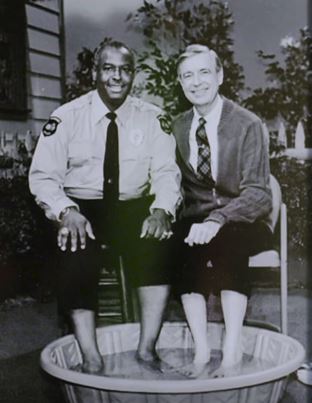
Officer Clemmons and Mister Rogers, from the video
Morning Open Thread is an open discussion forum for human interest news of the day, hobby and fun things, what you did on your vacation, and your local weather phenomena.
There will be several hosts, each host being responsible for picking a “theme of the day” and starting the discussion. However, there is no hard and fast rule about staying on topic, especially if you have a personal story burning a hole in your pocket trying to escape.
Pictures and videos are welcome in the comments. If photos are used, please be sure you own the copyright. We would rather see your personal photos anyway, rather than random stuff copied from the internet. Our only request is that if you use pictures or videos, take pity on those who don’t have broadband, and don’t post more than two or three in a single comment.
Morning Open Thread will be set to post at (or about) 6:30 AM Eastern Daylight Time. For those on international or military times, that is 1030 Zulu Time.
Sophie’s Hobson Choice on Maggies Bullet Farm: George Miller’s nearly aboriginal-free post-apocalypse vision or JJ Abrams’ non-LGBTQ utopian dystopia -— What a lovely day for Star War’s POC clone diversity already signalled
What remains certain is that Reconstruction failed, and that for blacks its failure was a disaster whose magnitude cannot be obscured by the genuine accomplishments that did endure.
– Eric Foner
By ann summers
The libertarian warlordism nationally rampant in the 1870s may yet return in the 21st Century, given its revival in the Second Reconstruction of the 1960s Civil Rights movement and its apparent reemergence in the post-9/11 period.
The Third Reconstruction might even deconstruct its predecessors. Unfortunately, unlike the Reverend Barber’s hopeful view, it could all go dystopian and sideways. The running joke on the left about libertarians needing to move to Somalia could come to fruition, just as RW domestic terror is on the uptick.
Federal troops always seem to make an appearance and it soon could be no different. Cinematic versions of a third Reconstruction and its warlord militias could resemble David Brin’s The Postman which was made into a film of the same name. Think TheBook of Eliwithout the Ted Cruz subtext. Or Mad Max movies with healthier warlords and more POC other than Tina Turner.
Another message of the plot deals with the backstory of the post-apocalyptic world: specifically, that it was not the electronics-destroying EMPs, the destruction of major cities, or the release of various bio-engineered plagues that actually destroyed society, but rather it was the Holnists themselves, who preyed on humanitarian workers and other symbols of civilization.
“Poor economic conditions caused voters to turn against the Democratic party. In the 2010 Congressional elections, the Republicans assumed control of the House. Public opinion made it difficult for the Obama Administration to develop a coherent policy.” Curiously, the history of the Panic of 1873 is described similarly noting of course the ideological reversals of Party identifications after WWII with the Dixiecrats’ defection and the GOP Southern Strategy.
The failure of reconstruction in the US coincided with the rise of reactionary racist insurgencies like the KKK, among others covert and overt in identification still operating today as Sons, Daughters, and citizens councils of whatever. Clearly national economic crisis dominated the period and helped shift US demography and economy as well as producing a pernicious Jim Crow racism that still remains as the pentimento for a diverse modern US society now expanded to other POC.
The monetary metalism of contemporary RW libertarianism has its roots in this post-Civil War period as well as the ideological shifts among the political parties still dependent on secessionized regional identities at the beginnings of the Progressive period.
The rise of RW militias and domestic terrorist cadres still outnumber the threats by any other groups and form those institutions that give cover for RW political institutions accumulating power and wealth on a model dating back to US anticommunism and fascism. These will be the basis for a future warlordism, the robber baronism for the 21st Century. Republican regionalism and the rise of local states as prolific as the stupidity of frontier social justice warriors(sic) in Eastern Oregon or Western Yemen.
fascists of a feather build pyramid schemes together
Today is the first day of a new feature series on Flowers for Socrates.
Sunrise on Roan Mountain in the Blue Ridge Mountains of Tennessee
Morning Open Thread is an open discussion forum for human interest news of the day, hobby and fun things, what you did on your vacation, and your local weather phenomena.
There will be several hosts, each host being responsible for picking a “theme of the day” and starting the discussion. However, there is no hard and fast rule about staying on topic, especially if you have a personal story burning a hole in your pocket trying to escape.
Pictures and videos are welcome in the comments. If photos are used, please be sure you own the copyright. We would rather see your own photos anyway, rather than random stuff copied from the internet. Our only request is that if you use pictures or videos, take pity on those who don’t have broadband, and don’t post more than two or three in a single comment.
Morning Open Thread will be set to post at (or about) 6:30 AM Eastern Daylight Time. For those on international or military times, that is 1030 Zulu Time.
The rarest, most daunting kind of poetry to write well is obvious yet original, and funny but profound, all at the same time.
Typically, young poets start out writing poetry steeped in angst and tortured imagery, because it’s much easier to be obscurely original, and sadly profound —
one reader might think you’re deep because they don’t understand you,
and another think you’re profound because your poems are depressing.
As Edwin Hubbel Chapin put it: “Some people habitually wear sadness, like a garment, and think it a becoming grace.” However, a large number of the world’s greatest poems have to be read over many times to reveal the layers of meaning, and they are often about loss — of youth, of love, of life. It takes long years of struggle to acquire the depth of feeling combined with experience that go into creating such exceptional poetry.
Billy Collins (1941 — ) writes the rare and daunting kind of poetry, and makes it look easy. He takes the everyday, and gives us a new way of seeing it. Many of his poems are wryly humorous, but they spring from a deep understanding of the human condition — all its pettiness and cruelty, all its kindness and greatness of spirit.
Who hasn’t suffered though the dreaded “ear worm” — a song or jingle that keeps repeating over and over again in your head? Collins describes it wonderfully, and takes us with him as he progresses through all its maddening stages — giving us a glimpse of an otherwise ordinary day in his life along the way.
MORE THAN A WOMAN
Ever since I woke up today, a song has been playing uncontrollably in my head–a tape looping
over the spools of the brain, a rosary in the hands of a frenetic nun, mad fan belt of a tune.
It must have escaped from the radio last night on the drive home and tunneled while I slept
from my ears to the center of my cortex. It is a song so cloying and vapid I won’t even bother mentioning the title,
but on it plays as if I were a turntable covered with dancing children and their spooky pantomimes,
as if everything I had ever learned was slowly being replaced by its slinky chords and the puff-balls of its lyrics.
It played while I watered the plants and continued when I brought in the mail and fanned out the letters on a table.
It repeated itself when I took a walk and watched from a bridge brown leaves floating in the channels of a current.
Late in the afternoon it seemed to fade, but I heard it again at the restaurant when I peered at the lobsters
lying on the bottom of an illuminated tank which was filled to the brim with copious tears.
Dubbed “the most popular poet in America” by Bruce Weber in the New York Times, Billy Collins, two-term U.S. Poet Laureate (2001-03), has published many poetry collections, including Questions About Angels, The Art of Drowning and Nine Horses: Poems. It was Questions About Angels, published in 1991, that put him in the literary spotlight.
Collins says his poetry is “suburban, it’s domestic, it’s middle class, and it’s sort of unashamedly that.” Here he reads poems from the viewpoints of two very different dogs. His dead-pan delivery reminds me of Bob Newhart. It’s easy to see why he’s a popular guest on National Public Radio programs:
detail…SIGNORELLI, Luca; Sermon and Deeds of the Antichrist, Fresco Chapel of San Brizio, Duomo, Orvieto 1499-1502 And in the midst of all the chaos we see the Antichrist, pausing in the middle of a sermon to hear what his demonic advisor instructs him to say next…
Much like the GOP base of middle-class conservative white privilege believing PBO to be a secret Muslim, false consciousness is an act of parapraxis. In language acts it can represent a type of crypto-praxis revealed in fascist rhetoric. Like its cousin, La Falange Cubana, there are hopes for varieties of End Times authoritarianism to realize textual prophecy.
Freudian slips (parapraxis) happen on this Carnival Cruz as Ted presents himself as the saviour from a treasonous POTUS by his gun-frying Canadian Baconness. For the GOP campaign, Cruz embodies the Southern Strategy even as his birth in southern Alberta is an entire act of self-forgetting or denial as false consciousness.
The synonomy of “Muslim” and “Terrorist” in RW media is a dangerous parapraxis in a country where non-Muslim domestic terrorists are in the majority. Trump’s citing a myth about Pershing shows how thin GOP tissues are.
In a November 2014 Senate speech, Cruz accused the president of being “openly desirous to destroy the Constitution and this Republic.”
In the same speech, Cruz invoked the speeches of the ancient Roman senatorCiceroagainst Catiline to denounce Obama’s planned executive actions on immigration reform.
Classics professor Jesse Weiner, writing in The Atlantic, said that Cruz’s analogy was “deeply disquieting” because “in casting Obama in the role of Catiline, Cruz unsubtly suggests that the sitting president was not lawfully elected and is the perpetrator of a violent insurrection to overthrow the government…In effect, he accuses the president of high treason.
Regardless of one’s views on immigration reform and the Obama administration at large, this is dangerous rhetoric.
And yet the implications for the use of pig meat here go beyond foodstuffs…
“Freud’s admiration for the artist marks an identification that makes his parapraxis an act of self–forgetting (Signorelli and Sigmund share the same first syllable).” at the level of the individual subject, this seems innocent but at a national level in the post-9/11 acts of self forgetting are mass acts of false consciousness. “Rome is the mob”(Gladiator).
False consciousness about POC is about that neocolonial Other, whether it’s African Americans saying early on that PBO was “not Black enough” or whether Vincent Chin lost his life because all Asians look alike and Chinese-Americans should be beat to death because Detroit off-shoring US car production to Japan created White unemployment. Nevermind the interlocking multi-national ownership of all car companies or that even now cars are assembled in places quite different from the site of their parts’ origins.
While Dominionists achieving power this would be a disaster for the United States, it also would most probably mark the end of humanity. The end game for these believers is “Resurrection” and the return of Jesus leading his armies to Armageddon marking the end of the world. In power, with nuclear armaments and a pretend Jesus to lead them, their ascendancy could well mark the end of of humanity. jonathanturley.org/…
US tank in Iraq with “New Testament” on the main gun
In an interview in the Kenyon Review in 2103, the poet Solmaz Sharif was asked: What have you learned about the writing process in the last five years?
“…I’m surprised to find that in addition to empathy, my writing requires a callousness. Maybe this is the nature of the material I immerse myself in—mostly testimony of warfare and imprisonment. Maybe this is the nature of the craft—that putting language, putting
music first requires a kind of violence.”
Every poem is an action. Every action is political. Every poem is political.
**
A lover, once: You can’t say every action is political. Then the word political loses all meaning. He added: What is political about this moment?
I was washing his dishes. I had left the water running.
**
Solmaz Sharif, the daughter of Iranian parents, was born in Istanbul, as she describes it, “en route out of the country, out of Iran. We went to Texas, then we went to Alabama, then we finally ended up in Southern California. We moved around a little bit there. It’s been a long route.”
In the 2013 Kenyon Review interview Sharif explained a major project: “I’ve been working on a poetic rewrite of the US Department of Defense’s Dictionary of Military and Associated Terms for several years now. My own experience as an Iranian born in Turkey beneath the long shadow of the Iran-Iraq War has always been an impetus behind this project. As an Iranian abroad, this experience was quintessentially American—the warfare was happening over there. Less American, perhaps, was being from the there. Regardless, the being from an elsewhere forced me to cultivate an image, as many have, of the home they left. An imagined place. This imagination-building happened to coincide with a war that killed 1,000,000 people. My father’s brother, a draftee, was one of those killed, shortly before I was born.”
Even after years of seeing and reading news reports and stories about the loss and devastation caused by cycles of war and terrorism in the Middle East, and the cost of reactionary policies in Europe and the Americas, her imagination and passion will take you into realities that sear your eyes and make you rethink what you believed you knew. There’s nothing comfortable about Sharif’s poetry, but her gift for the stark and telling detail will stick in your mind long after the pretty images of other writers have faded.
Lanat Abad / The Place of the Damned
this mangy plot where
by now only mothers still come,
only mothers guard the nameless plots
.
and then sparingly
.
Peepholes burnt through the metal doors
of their solitary cells,
.
just large enough for three fingers to curl out for a lemon to pass through for an ear to be held against for one eye then the other to regard the hallway to regard the cell and inmate
.
peepholes without a lens
so when the guard comes to inspect me, I inspect him.
Touch me, he said.
.
And through that opening
I did.
According to a 2004 British Ahwazi Friendship Society (BAFS) report on the ethnic cleansing of Iran’s Ahwazi Arab minority in the Al-Ahwaz region, their lands have been confiscated, the people forcibly relocated, or ‘disappeared’ — imprisoned, or executed and buried in mass graves in a place the government “calls ‘Lanat Abad’, the place of the ‘damned people’… The bodies do not stay long in the unmarked graves, before they are dug up and eaten by dogs.”






![dancing_queen_pink_1[1]](https://flowersforsocrates.com/wp-content/uploads/2016/04/dancing_queen_pink_11.jpg)





 Nicole Plyler Fisk
 Gene Howington
 FFS Guest Blogger
 Joy of Fishes
 Chuck Stanley
 shortfinals
 Terry Welshans
 ann li-summers
 wordcloud9


 Flowers For Socrates