
by Nona Blyth Cloud
I collect odd bits of historic detail and stray facts. I look for unlikely connections. Sometimes my mind wanders off in a completely new direction in the middle of a sentence, and what I started out writing turns into something else entirely.
So when I was looking at a list of poets born in April, this caught my eye:
Walter de la Mare and Ted Kooser were both born on April 25.

 Sir Walter de la Mare (1873-1956) was born in Kent, in southern England.His father was a Bank of England official. His mother was related to Robert Browning. Educated in London at St. Paul’s Cathedral Choir School, he worked for Anglo-American Oil Company(1890-1908) in London as a statistic clerk. His first story, ‘Kismet’ (1895), was published under ‘Walter Ramal.’ In 1908, he was awarded a yearly government pension of £100, and devoted himself entirely to writing. Better remembered for children’s stories and novels, his edition of collected poems was almost a 1,000 pages. Walter de la Mare twice declined a knighthood before he became a Companion of Honour (1948), and a member of the Order of Merit (1953).
 Ted Kooser (1939 – ) was born in Ames, Iowa. He received his B.A. from Iowa State and his M.A. in English from the University of Nebraska-Lincoln. Kooser worked for many years as a life insurance executive; now retired, he teaches half time at The University of Nebraska. Among many other honors, he was awarded two Writing Fellowships from the National Endowment for the Arts, won the 2005 Pulitzer Prize in Poetry, served two terms as U.S. Poet Laureate (2004-06), and had an elementary school named after him in 2009. Editor of a weekly newspaper column, “American Life in Poetry,” which is carried online and in over 150 newspapers, with a readership of 3.5 million. He lives on an acreage near the village of Garland, Nebraska.
Walter del al Mare was admired in his day for his ‘romantic imagination,’ and the eeriness of pieces like The Listeners, which still sends chills up my spine.
Ted Kooser is a poet and essayist, known for his honest, accessible verse, which often highlights fragments of a rural way of life that has largely vanished in America.
So are there points of comparison between two such different poets? See what you think:
— from Four Poems by Walter de la Mare
THINGS 
Things are the mind’s mute looking-glass —
That vase of flowers, this work-box here,
When false love flattered me, alas,
Glowed with a beauty crystal clear.
Now they are hostile. The tulip’s glow
Burns with the mockery of despair;
And when I open the box, I know
What kind of self awaits me there.
DEPRESSION GLASS
by Ted Kooser
It seemed those rose-pink dishes
she kept for special company
were always cold, brought down
from the shelf in jingling stacks,
the plates like the panes of ice
she broke from the water bucket
winter mornings, the flaring cups
like tulips that opened too early
and got bitten by frost. They chilled
the coffee no matter how quickly
you drank, while a heavy
everyday mug would have kept
a splash hot for the better
part of a conversation. It was hard
to hold up your end of the gossip
with your coffee cold, but it was
a special occasion, just the same,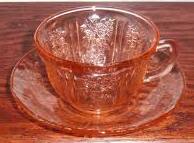
to sit at her kitchen table
and sip the bitter percolation
of the past week’s rumors from cups
it had taken a year to collect
at the grocery, with one piece free
for each five pounds of flour.
At first glance, there doesn’t seem to be much in common between these two poems, except glass and tulips. However, they are both using objects as symbols, and there was a time in the past when the objects meant something very different than they do in the present day of each poem. Both poets combine nostalgia with bitterness.
Continue reading →









 Nicole Plyler Fisk
 Gene Howington
 FFS Guest Blogger
 Joy of Fishes
 Chuck Stanley
 shortfinals
 Terry Welshans
 ann li-summers
 wordcloud9


 Flowers For Socrates